

Remote Employee Onboarding Without a Local Entity
Remote employee onboarding in Bangladesh is the process of hiring, contracting and starting a worker in Bangladesh for a company based elsewhere. Under its Employer of Record arrangement, PayrollBangladesh becomes the legal employer, issues the employment contract, registers the employee for tax and runs monthly payroll, while your company chooses the person and directs the work.
Which Hires Can You Onboard This Way?
PayrollBangladesh onboards two kinds of hire under the same Employer of Record arrangement, and the difference between them is the paperwork rather than the employment model. A Bangladeshi national can start once the contract is signed and tax registration is in place. A foreign national also needs work permit and visa approval before starting work in Bangladesh.
- ✔
Employment contract. Issued under Bangladesh law, carrying your confidentiality and intellectual property terms.
- ✔
Tax registration. Employee e-TIN registration and tax deducted at source on each payroll run.
- ✔
Payroll from the first month. Salary paid in BDT to a bank account in the name of the employee.
- ➤
Everything a local hire receives. Contract, tax registration and monthly payroll on the same terms.
- ➤
Work permit and visa processing. Applications prepared and tracked before the employee starts work.
- ➤
Additional documents. Extra documentation from both the employee and the sponsoring company.
Who Does What Once the Hire Is Made?
Onboarding through an Employer of Record splits one job in two. PayrollBangladesh holds the employment relationship in Bangladesh, and your company keeps everything to do with the work itself. The division below is what clients ask about first, because it decides who answers for the contract and who answers for the output.
- ✔
Employment contracts. Drafted under Bangladesh law, carrying your commercial terms and your IP assignment.
- ✔
Tax registration and deduction. Employee e-TIN registration and tax deducted at source on every payroll run.
- ✔
Monthly payroll. Currency conversion to BDT, bank transfer to the employee and a digital payslip each month.
- ✔
Statutory administration. Leave tracking, festival bonuses, record keeping and end-of-service settlement.
- ➤
Who you hire. You source or approve the candidate, interview and set the package.
- ➤
Day-to-day direction. Tasks, priorities, working hours and tools are yours to set.
- ➤
Performance. Reviews, objectives and progression decisions sit with your team.
- ➤
Ending the role. You make the commercial decision, and PayrollBangladesh administers the exit.
What Does an Employer of Record Commit To?
An Employer of Record arrangement rests on four commitments that stay in place for as long as the person is employed. Each one names who answers for what, so a foreign company can see where its own responsibility stops and where the responsibility of PayrollBangladesh begins.
What Does PayrollBangladesh Handle as Employer?
Each item below is a task that either happens or does not, so the service can be held to it rather than described in general terms. Together they make up the operational scope of PayrollBangladesh for a remote hire in Bangladesh, from the signed contract to the final settlement when the engagement ends.

How Does Remote Onboarding Run, Step by Step?
This is the order the work happens in, from the moment you confirm a candidate to the first payslip. The early steps are documentation. Later steps, such as work permit approval for a foreign national, depend on government processing that sits outside the control of PayrollBangladesh. Building a whole team rather than one hire? See offshore HR onboarding.
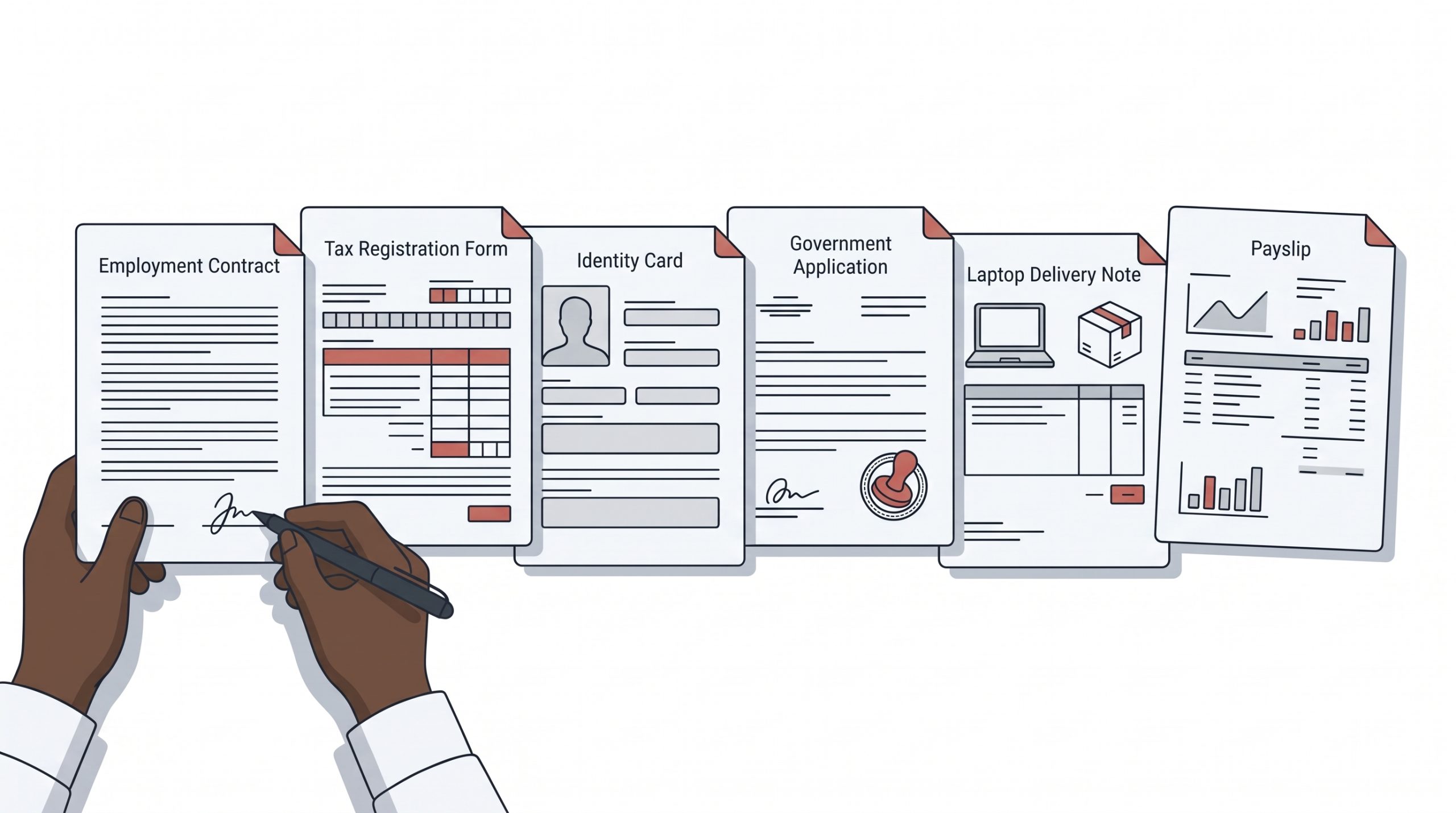
Role and package confirmation
You confirm the role, the salary and the start date. PayrollBangladesh structures the package into base pay and allowances for local payout and flags anything that needs restructuring before a contract is drafted. The confirmed package becomes the basis for both the contract and the first payroll run.
Contract drafting and signature
PayrollBangladesh prepares an employment agreement under Bangladesh law that carries your confidentiality and intellectual property terms, so work produced during employment belongs to your company. The draft is shared with your company for review before the employee is asked to sign it.
Documents and verification
The employee supplies identity documents, academic and employment records and bank details. PayrollBangladesh checks that the set is complete before anything is filed. Missing or unclear documents are raised with the employee at this point, so later filings are not held up.
Tax registration and banking
PayrollBangladesh registers the employee for an e-TIN and confirms the salary account for direct deposit. For a foreign national, work permit and visa processing starts at this stage. Completing tax registration here lets deduction at source apply from the first payroll run.
Equipment and first day
Equipment and device arrangements are agreed for each hire rather than included by default. The onboarding paperwork is completed and the employee starts working with your team. Device provision, account access and ownership of the equipment are set out in the agreement.
First payroll and ongoing support
The first payslip is issued with deductions applied. From then on PayrollBangladesh runs monthly payroll, manages leave requests and handles everyday HR questions for your Bangladesh team. Payroll inputs and approvals from your managers are agreed so that each monthly run has what it needs.
| Step | What it produces | Who acts |
|---|---|---|
| 1. Role and package confirmation | Confirmed role, salary and start date, split into pay and allowances | Your company and PayrollBangladesh |
| 2. Contract drafting and signature | Employment agreement carrying your confidentiality and IP terms | PayrollBangladesh drafts, your company reviews |
| 3. Documents and verification | A complete, checked set of identity, education and bank documents | The employee and PayrollBangladesh |
| 4. Tax registration and banking | e-TIN registration and a confirmed salary account, plus permit filing for foreign hires | PayrollBangladesh |
| 5. Equipment and first day | Agreed equipment arrangements and completed onboarding paperwork | Your company and PayrollBangladesh |
| 6. First payroll and ongoing support | First payslip with deductions, then monthly payroll and leave records | PayrollBangladesh |
Which Hiring Route Fits Your Plans?
An Employer of Record, a staffing agency and your own entity are often treated as alternatives to the same problem. They are not. They differ in who legally employs the worker, who holds the employer obligations and whether you need a company in Bangladesh first. Our guide Employer of Record or staffing agency compares the first two in more detail.
| Factor | Employer of Record | Staffing agency | Your own entity |
|---|---|---|---|
| Who employs the worker | PayrollBangladesh | The agency | Your local company |
| Who directs the work | Your managers | Varies by contract | Your managers |
| Local company needed | No | No | Yes, through RJSC registration |
| Who holds employer obligations | PayrollBangladesh | The agency | Your company |
| Suits you when | You want a long-term team member without registering a company | The engagement is short-term or temporary | You are committing to Bangladesh at scale through foreign entity setup |
Which Payments Does a Bangladesh Hire Involve?
Each remote hire in Bangladesh involves payments to the employee, to the National Board of Revenue and, for a foreign national, to the government departments that process permits. The table shows each component, what it covers and who receives it, so you can see where every payment goes before the first payroll run. Each engagement is scoped individually around the role.
| Component | What it covers | Who receives it |
|---|---|---|
| Gross salary | The compensation you agree, split into base pay and allowances | The employee, in BDT |
| Statutory benefits | Festival bonuses and leave entitlements carried in the contract | The employee |
| Tax deducted at source | Withheld from salary at the applicable rate | National Board of Revenue |
| Work permit fees | Government application and processing costs, for foreign nationals only | Government departments |
Which Rules Apply From the First Day?
Employment in Bangladesh is governed by the Bangladesh Labour Act, 2006, which sets the baseline for appointment, working hours, leave and notice for the workers it covers. Three requirements catch foreign employers out most often, and each one is dealt with before the employee starts work.

Employees need a taxpayer identification number from the National Board of Revenue, and PayrollBangladesh, as employer, deducts tax from salary at source.
Expatriate employees need work permit approval before they start, which for employers under its remit is administered by the Bangladesh Investment Development Authority. See work permit support and work visa processing.
Employing directly means registering with the Registrar of Joint Stock Companies and Firms first. See company registration or branch office setup. An Employer of Record removes that step.
What Do Employers Ask Before Onboarding?
These are the questions foreign companies ask most often before onboarding their first employee in Bangladesh through PayrollBangladesh. They cover scope, accountability, governing law, data handling, timing and what happens after you get in touch. Each answer opens with the direct answer. Select any question to open it.
Do I need a company in Bangladesh to hire someone there?
No. PayrollBangladesh holds the employment relationship on your behalf, which removes the requirement to register a local entity. You would need your own company only if you intend to trade in Bangladesh directly or build a large local operation.
Who is legally responsible as the employer?
PayrollBangladesh is. As the Employer of Record, it is the employer named in the employment contract and holds the employer obligations that come with it, such as payroll, tax deduction at source and employment records. Your company directs the daily work and manages performance.
Which law governs the employment contract?
Bangladesh law governs it. The Bangladesh Labour Act, 2006 sets the baseline for covered workers, including appointment, leave and notice, and the contract adds the commercial terms your company specifies.
Who owns the work our employee produces?
Your company. Intellectual property and work product ownership are set in the employment contract, which PayrollBangladesh drafts to the terms you specify, the same as you would for a direct hire.
How is employee information kept confidential?
Employee information is used for the employment, payroll and tax tasks set in your agreement, and the agreement names who at your company receives employee records. Confidentiality terms that protect your business information are written into the employment contract.
How is this different from using a recruitment firm?
A recruitment firm introduces candidates and the engagement ends there. Onboarding through an Employer of Record continues after the hire, with contracts, tax registration, payroll, leave and ongoing administration handled by PayrollBangladesh for as long as the person is employed.
Can you onboard expatriates as well as Bangladeshi nationals?
Yes. Expatriate onboarding adds work permit and visa processing to the sequence and needs additional documentation from both the employee and the sponsoring company. Government processing time sits outside the control of PayrollBangladesh.
How long does onboarding take?
It depends on the hire, so no fixed timetable is promised. A Bangladeshi national can start once the contract is signed and the documents are verified. A foreign national also needs work permit and visa approval, and the time that takes depends on government processing.
How are leave and festival bonuses handled?
Through monthly payroll. Casual, sick and earned leave are tracked against the contract and reported to your managers, and festival bonuses are calculated and paid as part of payroll.
What happens after I send an enquiry?
PayrollBangladesh starts by scoping the hire in four steps:
- Your company shares the role, salary band, start date and whether the hire is local or foreign.
- PayrollBangladesh confirms what the onboarding involves for that hire.
- The scope and terms of the engagement are agreed.
- Contract drafting begins.
Can we move an existing employee or provider to you?
You can raise a move in your enquiry. It starts with the facts that shape the new arrangement: who employs the person today, what the current agreement covers and which tasks need to transfer. PayrollBangladesh then confirms what it can take on.
What happens if we want to end the employment?
PayrollBangladesh administers the exit. Notice periods, final settlement and any end-of-service entitlement follow the Bangladesh Labour Act, 2006 and the terms of the contract, while your company sets the commercial decision and the date.
Is there anything an Employer of Record cannot do?
Yes. An Employer of Record employs your staff, but it does not give your company its own legal presence in Bangladesh, so it cannot let you trade locally or sign local contracts in your own name. For that you need your own entity, through company registration or a branch office.
Legal reference for this page
This page relies on the Bangladesh Labour Act, 2006, Act No. 42 of 2006, dated 11 October 2006 and published by the Ministry of Law, Justice and Parliamentary Affairs. Section 4(7) treats a worker as permanent once employed on a permanent basis or after completing the probation period satisfactorily. Section 4(8) sets the probation period at six months for clerical work and three months for other workers, subject to the proviso that follows it. Whether a role is covered depends on the scope and definitions of the Act.