

Payroll Built for Scrutiny
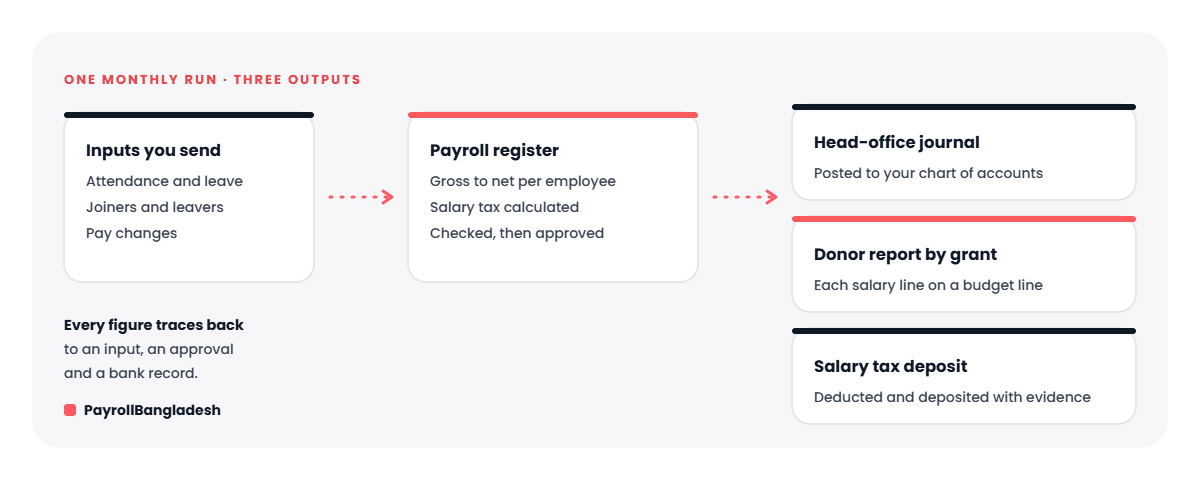
Subsidiary and INGO payroll in Bangladesh, run end to end. We process monthly salaries, salary tax, provident fund and final settlements, and we produce the records your head office, your auditors and your donors ask for. Your entity stays the employer, and every figure traces back to an input, an approval and a bank record.
- Bangladesh Labour Act 2006
- Income Tax Act 2023
- Donor-ready reports
- English reporting
- USD or BDT invoicing
Your monthly payroll cycle
- Attendance, leave and changes collected
- Draft payroll register prepared
- Your finance lead approves
- Salaries paid to staff bank accounts
- Salary tax and fund deposits made
- Payslips and reports delivered
What is subsidiary and INGO payroll?
Subsidiary and INGO payroll is outsourced monthly payroll for an organisation that already has its own presence in Bangladesh. Your subsidiary, branch office, liaison office or registered country office stays the legal employer. PayrollBangladesh calculates salaries, deducts and deposits salary tax, administers provident fund, pays staff, issues payslips and prepares the records your head office, your auditors and your donors ask for, under the Bangladesh Labour Act 2006 and the Income Tax Act 2023.
Built for Two Employer Types
Both need accurate local payroll, but they answer to different people: a foreign subsidiary to its group finance team, an INGO to its headquarters and its donors.
Subsidiaries and branch offices
- Monthly payroll that matches your group’s chart of accounts and cost centres
- Salary tax deducted at source and deposited every month
- Payroll for expatriate staff with BIDA work permits, alongside local staff
- Records for statutory audit and transfer-pricing support
- Board and head-office reports in English
INGOs and donor-funded projects
- Salary costs split by project, grant and donor code
- Timesheets and level-of-effort records linked to each payment
- Payroll for foreign staff cleared through the NGO Affairs Bureau
- Separate registers and reports for each donor audit
- Fast final settlements when a project ends
What the Service Covers
One team handles the full payroll cycle, so you deal with one contact, one monthly report and one invoice.
Monthly payroll processing
Gross-to-net calculation for every employee: basic, allowances, overtime, bonuses, deductions and arrears, checked against your approved inputs before anyone is paid.
Salary tax deduction
Tax deducted from salaries each month, deposited on time and reported in the employer’s withholding returns.
Payslips and records
Clear payslips for every employee, in English, each month.
Provident fund records
Contributions and accruals calculated under your fund rules and policy.
Festival bonus runs
Calculated and paid on schedule for eligible staff.
Joiners and final settlements
Pro-rata pay for new staff, and full final settlements for leavers, including leave encashment, gratuity and any notice pay, paid within the legal deadline.
Expatriate staff payroll
Salaries for foreign staff, tax on their Bangladesh income, and the paperwork their bank needs to send part of their pay home.
Head-office and donor reports
Payroll journals, cost-centre and grant allocations, headcount and variance reports in the format your finance team uses.
How the Monthly Cycle Runs
Every month runs on a fixed calendar agreed at onboarding, with your approval before any money moves.
- Step 1
Get the data
Attendance, leave, joiners, leavers and pay changes.
- Step 2
Work out pay
Gross-to-net, tax, fund and bonus calculations.
- Step 3
Check the run
Draft register and variance report sent to you.
- Step 4
You sign off
Your finance lead signs off the payroll.
- Step 5
Pay the staff
Salaries, tax and fund deposits made on time.
- Step 6
Send the reports
Payslips, journals and donor allocations delivered.
Bangladesh Rules That Apply
The main rules your Bangladesh payroll must follow. We build each one into the monthly cycle, the same way we do on our payroll service and in our payroll outsourcing process.
| Item | What applies |
|---|---|
| Employment law | Bangladesh Labour Act 2006, as amended, and the Bangladesh Labour Rules 2015 |
| Salary payment date | Section 123 of the Labour Act 2006 requires wages within seven working days of the end of the wage period |
| Final settlement | Section 123 gives thirty working days from the date employment ends, however it ends |
| Salary tax | The employer deducts income tax from salaries at source under the Income Tax Act 2023 and deposits it with the government |
| Provident fund | Chapter XVII of the Labour Act 2006 governs a provident fund where one is established for the establishment |
| Festival bonus | Not a fixed statutory amount. Rule 19(4)(i) of the Labour Rules 2015 requires the appointment letter to state festival allowance and gratuity, if any. We run it to the policy you set. |
| Foreign staff in companies | Expatriates need a work permit, normally from BIDA, before they can be paid in Bangladesh |
| Foreign staff in INGOs | Appointment of foreign nationals by an NGO needs clearance from the NGO Affairs Bureau |
| Expatriate remittance | Bangladesh Bank allows up to 80% of earned net income after tax to be remitted during the year. The remaining 20% follows the year-end tax assessment. |
Sources: Labour Act 2006, section 123; Labour Rules 2015, rule 19(4)(i); Income Tax Act 2023; Bangladesh Bank FEPD Circular Letter No. 33, 27 December 2021.
| What differs | Foreign subsidiary | INGO country office |
|---|---|---|
| Employer on the appointment letter | Your subsidiary, branch or liaison office | Your registered country office |
| Who reads the monthly report | Group finance and your auditors | Donors, head office and the NGO Affairs Bureau |
| How cost is allocated | Cost centre and chart of accounts | Project, grant and budget line |
| Clearance for foreign staff | A valid work permit before they are paid | NGO Affairs Bureau clearance for foreign nationals |
| Reporting currency | USD or BDT | Donor currency alongside BDT |
Rules as reviewed in October 2026. Labour law was amended in 2025 and 2026, and some changes still await implementing rules; we apply each change as it takes effect.
Payroll Donors Can Audit
Donors and auditors want to see that every taka of staff cost was earned, approved and charged to the right grant. We build that trail into the payroll itself, not after the fact.
For subsidiaries, the same structure supports group audits and cost recharges between entities.
- Grant and project codingEach salary line is charged to the project, grant or donor code you set.
- Level-of-effort recordsTimesheets are linked to the pay they support.
- Audit trailApprovals, changes and payments are logged with names and dates.
- Donor-specific reportsSeparate registers and summaries for each donor review.
- Project close-outFinal settlements and records completed when a grant ends.
- Data protectionStaff pay data shared only with named people in your organisation.
Why Employers Choose Us
We work with companies and organisations from North America, Europe, Australia and the Middle East that need Bangladesh payroll done properly.
One accountable team
Payroll, salary tax and fund administration handled by one team in Dhaka, with one named contact.
Bangladesh law and filings
We work to the Labour Act 2006 and the Income Tax Act 2023, and we name the rule behind every deduction we make.
Pay data stays private
Salary data goes only to the people you name, and reports can be issued with names and account numbers masked.
Local and expatriate staff sit on one payroll run, each with the right tax treatment.
We invoice in USD or BDT, whichever your finance team prefers.
Every payment traces back to an input, an approval and a bank record.
Hiring before your Bangladesh entity exists is our Employer of Record service.
Paying contractors rather than employees is our Agency of Record service.
Hiring engineers rather than moving an existing payroll is our tech recruitment service.
Paying someone as a contractor who works like an employee is our contractor to employee conversion service.
Questions We Are Asked Most
Answers to what finance and HR leads ask before moving their Bangladesh payroll to us.
Can a subsidiary outsource payroll?
Yes. The subsidiary, branch or liaison office stays the legal employer and keeps control of hiring and pay decisions. We run the monthly payroll for it: salary calculations, salary tax, provident fund, payslips, payments and reports, after your finance lead approves each month’s register.
How does INGO payroll work?
We run the same monthly cycle, and also charge each salary line to the project, grant or donor code you set, link timesheets to pay, and prepare separate reports for each donor audit. Foreign staff are paid once their appointment is cleared by the NGO Affairs Bureau.
Who deducts and deposits salary tax?
The employer is responsible for deducting income tax from salaries under the Income Tax Act 2023. We calculate the deduction each month, deposit it on your behalf and prepare the withholding returns for your signature.
When must salaries be paid in Bangladesh?
Section 123 of the Bangladesh Labour Act 2006 sets the deadline. Regular wages must be paid within seven working days of the end of the wage period, and all dues on termination within thirty working days of the date employment ends, however it ends. We build both deadlines into the monthly cycle.
Can you run payroll for expatriate staff?
Yes. Expatriates are paid on the same payroll once they hold a valid work permit, from BIDA for companies or with NGO Affairs Bureau clearance for INGOs. We calculate their Bangladesh tax and give their bank the salary documents it needs. Bangladesh Bank allows up to 80% of earned net income after tax to be remitted during the year, with the balance after the year-end assessment.
What do you need to start?
An employee list with salaries and bank details, your pay structure and policies, tax identification numbers, provident fund and gratuity rules, your cost centres or grant codes, and the name of the person who approves payroll.
What if we have no entity yet?
Yes. Through our Employer of Record service we become the legal employer of your staff in Bangladesh, so you can hire before setting up a subsidiary or registering an INGO office.
How do you invoice international clients?
We invoice in USD or BDT, whichever suits your finance team, with the payroll funding and our service fee shown separately.
Can you take over from our provider?
Yes. We run one parallel cycle first, so your current provider’s figures and ours are compared line by line before anything changes. We carry over opening balances, year-to-date tax and fund positions, then cut over at a month end. Where you also need a local presence, see compliance and risk mitigation.
How do you protect our payroll data?
Salary data goes only to the people you name on your side. Reports can be issued with employee names and bank account numbers masked, so they can go to auditors, donors or a head office without exposing personal data. Access is withdrawn when a named person leaves either organisation.
What happens after we enquire?
We ask for your headcount, pay structure and current arrangement, then send a written scope and fee. If you go ahead, we take your employee data, run a parallel cycle against your last closed month, and agree the cut-over date with your finance lead before we run anything live.
Can you sign our donor audit report?
No. We are a payroll provider, not a licensed audit firm, so we cannot sign an audit opinion or certify statutory accounts. What we do is hand your auditor the payroll register, the approvals, the bank records and the tax deposit evidence behind every figure, in the format they ask for.
Payroll Rules and References
The primary sources behind the rules on this page. Each one is the official text, not a summary.
Labour Act 2006 text
The employment law your Bangladesh payroll runs under. Read the Act.
When wages are due
Section 123 sets seven working days for wages and thirty for final dues. Read section 123.
Income Tax Act 2023
The Act behind salary tax deducted at source. Open the NBR text.
NGO Affairs Bureau
FD-6 for project approval, FD-7 for emergencies, FC-1 for one-time contributions. Visit the Bureau.
Move Your Payroll to a Specialist
Tell us your headcount, entity type and reporting needs. We will set out the payroll calendar, reports and fee for your subsidiary or INGO office.
PayrollBangladesh · Rupayan Shopping Square, Suite 610, Bashundhara R/A, Dhaka 1229 · +880-1711-990010 · info@payrollbangladesh.com
Last updated 30 October 2026. Reviewed by Romana Akter Shila, Chief Executive Officer, PayrollBangladesh, 8 years in EOR and payroll operations. This page is general information, not legal or tax advice.