

Corporate Payroll Services in Bangladesh for Foreign & Local Companies
Payrollbangladesh runs your monthly payroll cycle end-to-end — BDT salary disbursement, NBR TDS withholding & deposit, Bangladesh Labour Act 2006 compliance, and audit-ready records — so finance and HR leaders can pay staff in Bangladesh without a local entity, penalties, or in-house payroll headcount.
Corporate Payroll Services Built for Bangladesh Operations
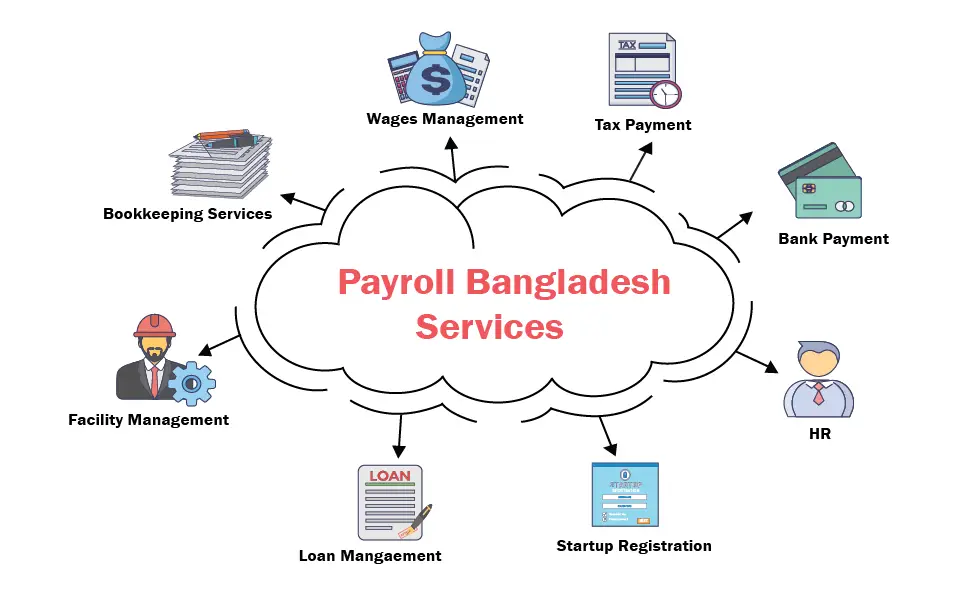
We take over the complete monthly payroll function for companies employing staff in Bangladesh — from gross-to-net calculation and NBR tax deduction to payslips, statutory filings and audit records — under one fixed fee per employee. Three kinds of businesses use this service:
Foreign companies hiring in Bangladesh
Staff in Bangladesh but no local payroll team, and often no local entity. We run payroll in BDT, withhold and deposit NBR tax, and pair this with our Employer of Record track when no entity exists.
Bangladeshi enterprises leaving spreadsheets
Payroll sits with one accountant, overtime and festival bonuses are calculated by hand, and every Finance Act change is a risk. We move you to a reviewed, documented monthly cycle backed by NBR-audit-ready registers.
Scale-ups, BPO and ITES teams
Headcount changes every month, with joiners, leavers, expat allowances and cost-centre reporting your finance team needs on time. We absorb the volume and hand you GL-ready journals and department-wise reports.
What Is Included in Our Corporate Payroll Service?
Our corporate payroll service in Bangladesh includes nine deliverables: monthly salary processing, NBR TDS deduction and deposit, payslips, withholding-tax returns, annual employee returns, WPPF administration, provident-fund and final-settlement handling, statutory records and a monthly reporting pack. Fees are fixed per employee per month with no per-transaction surcharges.
Salary processing
Gross-to-net for every employee in BDT: basic pay, house rent, medical, conveyance, festival bonuses and overtime at twice the normal rate under the Labour Act 2006.
TDS deduction & deposit
NBR progressive slab rates applied, 0%–30% for residents and 30% flat for non-residents, with tax deposited through the NBR e-payment portal before the deadline.
Payslip issuance
Individual digital payslips showing gross pay, statutory deductions, TDS and net pay, delivered by email to every employee on pay day each month without fail.
Withholding-tax return
Employer withholding-tax return prepared, reconciled against the monthly TDS deposit and filed with the NBR within the prescribed cut-off after every month-end.
Annual income-tax return
Salary certificates assembled and employee returns filed inside the NBR year-round calendar under the Finance Act 2026, targeting the early-filing rebate window.
WPPF administration
Workers’ Profit Participation Fund contributions computed and remitted, 5% of net profit before tax, wherever your company meets the Labour Act capital thresholds.
Provident fund & final settlement
Employer and employee provident-fund contributions tracked, and leaver settlements computed: notice pay, leave encashment and final dues released on exit.
Statutory records
Salary, deduction, provident-fund and WPPF registers maintained in an audit-ready archive and retained for the full statutory period to withstand NBR review.
Reporting pack
Headcount, cost-centre and department-wise payroll reports in Excel or PDF, plus year-to-date accruals and GL journals delivered to your finance team monthly.
Compliance frame: Bangladesh Labour Act 2006 (ss.100–108 hours & overtime; Chapter XV WPPF), Income Tax Act 2023 as amended by the Finance Act 2026, National Board of Revenue (nbr.gov.bd). Monthly payroll-cycle practice per Payoneer’s Bangladesh payroll guide. See also our Statutory Compliance service.
Why Do Foreign & Local Companies Choose Payrollbangladesh?
Companies choose Payrollbangladesh because the service is built only for Bangladesh payroll: NBR slab rates under the Finance Act 2026, Labour Act 2006 overtime and WPPF rules, BDT settlement and NBR filings are handled by one accountable team for a fixed monthly fee per employee, with no local entity required when paired with our EOR track.
Bangladesh-only focus
Every process is built around NBR rules, the Labour Act 2006 and BDT settlement, never adapted from a generic global payroll template.
Compliance-first pipeline
TDS calculated at NBR slab rates under the Finance Act 2026, remitted through the e-payment portal and reconciled against the register every month.
Foreign-company ready
No local entity in Bangladesh yet? Pair this service with our EOR, Company Registration or Branch Office tracks and start paying staff first.
Fixed monthly pricing
One per-employee-per-month fee with no hidden per-payslip or per-filing surcharges, a predictable line item your finance team can budget for.
Data-secure workflows
Encrypted payroll files, role-based access and NDA-protected transfers with your HR system, with every statutory record retained for NBR audit.
Single point of accountability
One dedicated payroll manager per client, backed by a compliance reviewer who signs off every run, with no ticket-queue support desk in between.
How Does Our Corporate Payroll Process Work?
Our corporate payroll process runs in six steps each month: a discovery call, master-data setup, a fixed monthly input window, a reviewed payroll run with variance check, client approval and salary disbursement on the last working day, then NBR filings, payslips and GL journals. Onboarding takes 5–10 business days.
- 01Discovery & scope call. We map headcount, salary structures, benefits and special items such as festival bonuses, expat allowances, provident fund and WPPF before anything is configured.
- 02Master data setup. Employee, tax, cost-centre and pay-element masters are configured, then validated against Bangladesh Labour Act 2006 minimums and the current NBR tax masters.
- 03Monthly input window. You send attendance, overtime, joiners, leavers and one-off items through a secure template on a fixed cut-off date every month.
- 04Payroll run & QC. Gross-to-net is calculated, TDS applied at progressive NBR rates, a variance report against the prior month produced, and a reviewer signs off.
- 05Client approval & disbursement. You approve the payroll register; salaries are disbursed on the last working day of the month, in line with Bangladesh’s standard payroll cycle.
- 06Filings, payslips & audit trail. TDS remitted through the NBR e-payment portal, withholding-tax return filed in window, payslips distributed and GL journals handed to your finance team.
Bangladesh Payroll Compliance Checklist We Own
Every monthly close is measured against this checklist. If any item slips, our reviewer holds the payroll run.
- ✓Salary payment on the last working day of each calendar month, per Bangladesh’s standard monthly payroll cycle (Payoneer Bangladesh guide).
- ✓TDS at NBR progressive rates (0%–30% resident, 30% flat non-resident) computed each pay period.
- ✓Overtime at 2× normal rate, capped at 2 hours per day, computed on Basic + DA + ad-hoc wage per Bangladesh Labour Act 2006.
- ✓Withholding-tax return filed with NBR by the prescribed deadline after month-end via the NBR e-payment portal.
- ✓Tax-free threshold applied correctly — BDT 400,000 general threshold under the Finance Act 2026, plus the higher category thresholds for women, 65+, disabled and third-gender employees.
- ✓Employment-income exemption — one-third of employment income or BDT 500,000, whichever is lower (Finance Act 2026; previously BDT 450,000).
- ✓WPPF administration where the company meets the capital / asset thresholds — 5% of net profit before tax.
- ✓Annual return filing inside the NBR year-round calendar introduced by the Finance Act 2026 — filed in the first window for the early-filing rebate.
- ✓Wages paid within the statutory deadline — Labour Act 2006 s.123 requires payment within seven working days after the wage period; our run closes before that cut-off.
Primary sources: Bangladesh Labour Act, 2006 (Act 42 of 2006) — bdlaws.minlaw.gov.bd; Income Tax Act 2023 — National Board of Revenue; Finance Act 2026 (Parliament, 29 June 2026).
Bangladesh Personal Income Tax & TDS Rates We Apply
Our payroll engine applies the current NBR progressive slab rates every month. Below are the brackets we use for salary TDS on resident employees for income year 2026/27 (1 July 2026 – 30 June 2027), as enacted by the Finance Act 2026. The former 5% slab no longer exists.
| Annual taxable income (BDT) | Marginal rate | Applies to |
|---|---|---|
| Up to 400,000 | 0% | Tax-free threshold (general taxpayer) |
| 400,001 – 700,000 | 10% | Next 300,000 |
| 700,001 – 1,100,000 | 15% | Next 400,000 |
| 1,100,001 – 1,600,000 | 20% | Next 500,000 |
| 1,600,001 – 3,600,000 | 25% | Next 2,000,000 |
| More than 3,600,000 | 30% | Top slab |
| Non-resident salaried employees | 30% | Flat withholding, no slab benefit |
Source: Finance Act 2026 (Parliament, 29 June 2026 — general threshold BDT 400,000 for FY2026-27 and FY2027-28), read with the Income Tax Act 2023. Higher tax-free thresholds apply to women, taxpayers aged 65+, persons with disabilities, third-gender taxpayers and gazetted freedom fighters; we apply the category threshold on file for each employee. Minimum tax applies once income crosses the threshold. Related: Tax Planning and Expatriate Management for non-resident and expat payroll.
In-House Payroll vs. Payrollbangladesh — Direct Comparison
The only independent cost benchmark we cite is the PwC study for ADP Canada (2012), which found outsourced payroll costs about 30% less than in-house processing. The rows below are the operational differences we see on Bangladesh engagements.
| Dimension | In-house payroll | Payrollbangladesh (outsourced) |
|---|---|---|
| Cost per paycheque | Higher — PwC / ADP Canada found in-house processing costs ~30% more than outsourced | Fixed monthly fee per employee; no per-transaction surcharges |
| Headcount required | Dedicated payroll accountant + backup + tax filer | Zero internal payroll headcount required |
| NBR filings | Owner responsibility — late filings attract NBR penalties | Owned, tracked, and filed on your behalf |
| Labour Act 2006 overtime | Frequently miscalculated when bonuses are folded into the base wage | Applied at strict 2× rate on Basic + DA + ad-hoc wage per the Act |
| Software & updates | Annual licensing + patch cost + training | Included |
| Audit readiness | Files scattered across email, spreadsheets, HR system | NBR-audit-ready register maintained by default |
| Peak-month capacity | Constrained by staff availability during festival bonuses, year-end | Scaled operations team — no bottleneck |
| Business continuity | Single-person dependency risk | Team-owned; documented SOPs |
Cost source: PwC for ADP Canada, The Hidden Reality of Payroll & HR Administration Costs (2012), as reported by Canadian HR Reporter. Considering a full outsourced function instead of a managed run? See Payroll Process Outsourcing.
How Much Does Corporate Payroll Cost in Bangladesh?
Corporate payroll in Bangladesh is priced as a fixed monthly fee per employee, which falls as headcount grows. There are no per-payslip or per-filing surcharges; NBR remittance, payslip delivery and audit-ready records are included in every tier. A written per-employee quote is issued after the discovery call.
| Tier | Headcount band | Fit | What’s included |
|---|---|---|---|
| Starter | 1 – 10 employees | Foreign companies hiring first Bangladesh staff; startups | Full monthly payroll, TDS, payslips, WHT filings |
| Growth | 11 – 50 employees | Scale-ups with mixed local + expat headcount | Starter + cost-centre reporting + provident fund admin |
| Enterprise | 51+ employees | Multi-department corporates, BPO/ITES firms | Growth + dedicated payroll manager + custom GL integration + quarterly audit review |
All tiers include NBR e-payment remittance, employee payslip delivery, and NBR-audit-ready record-keeping. Contact us for a written per-employee-per-month quote.
Frequently Asked Questions — Corporate Payroll Services in Bangladesh
What does “corporate payroll service in Bangladesh” include?
A corporate payroll service in Bangladesh runs the full monthly pay cycle for a company’s employees: gross-to-net calculation in BDT, NBR TDS deduction at progressive rates (0%–30% for residents under the Finance Act 2026; 30% flat for non-residents), salary disbursement on the last working day of each month, payslip issuance, monthly withholding-tax filings with the NBR, and annual employee tax-return preparation inside the NBR filing calendar. Payrollbangladesh delivers all of these as a single managed service under a fixed monthly fee.
Do foreign companies without a local entity in Bangladesh qualify?
Yes. Foreign companies commonly pair our corporate payroll service with our Employer of Record (EOR) track — we hire your Bangladesh staff on your behalf and run their payroll, so no local entity is required. If you plan to open a local entity later, we can also handle company registration or a branch office.
How much can outsourcing payroll actually save vs. running it in-house?
The most-cited independent benchmark is the PwC study commissioned by ADP Canada (2012, 125 employers): payroll run by a service provider cost about 30% less than in-house processing, and organisations under-estimated their true in-house payroll and HR administration cost by around 40% (Canadian HR Reporter). That study is Canadian and over a decade old, so treat it as directional. Your exact savings depend on headcount, current in-house cost, and salary complexity — we quantify the delta during the discovery call.
What NBR filings do you own each month and each year?
Monthly: TDS deposit through the NBR e-payment portal and the employer’s withholding-tax return filed within the prescribed cut-off after month-end. Annually: employee income-tax return filing inside the NBR calendar — the Finance Act 2026 replaced the single November deadline with year-round filing, with a rebate for early filers and a surcharge for late filers — plus WPPF filings where the company meets the Labour Act capital/asset thresholds (see Statutory Compliance).
How do you calculate overtime under Bangladesh Labour Act 2006?
The Bangladesh Labour Act, 2006 sets a 48-hour work-week with overtime capped at 2 hours per day and compensated at twice the normal rate. Our engine applies the double-rate on Basic + Dearness Allowance + ad-hoc wage only — festival bonuses and one-off payments are excluded from the overtime base, which is where in-house teams most commonly miscalculate.
Is my payroll data secure?
All transfers are encrypted, access is role-restricted, and every engagement is covered by a signed NDA. Records are retained in an NBR-audit-ready archive for the statutory period. We do not host payroll data outside contracted infrastructure.
How quickly can we go live?
Standard onboarding runs 5–10 business days from signed engagement, depending on the completeness of employee master data. The first payroll run is delivered in the first full month after onboarding closes.
Can you integrate with our accounting or HRIS system?
Yes. We deliver monthly GL journal entries in your finance team’s chart-of-accounts format and can send flat-file exports to common HRIS systems. For Enterprise-tier engagements we build a custom bridge to your ERP.
What is the tax-free income limit in Bangladesh for FY2026-27?
The general tax-free threshold for individuals is BDT 400,000 for income year 2026-27 (1 July 2026 – 30 June 2027), set by the Finance Act 2026 passed on 29 June 2026, up from BDT 375,000. Higher thresholds apply to women, taxpayers aged 65 and above, persons with disabilities, third-gender taxpayers and gazetted freedom fighters. Salary above the threshold is taxed at 10%, 15%, 20%, 25% and 30% slabs.
What is the TDS rate on salary in Bangladesh?
There is no single TDS rate on salary in Bangladesh. The employer estimates each employee’s annual taxable salary, applies the progressive slabs (0% up to BDT 400,000, then 10%, 15%, 20%, 25% and 30%) after the employment-income exemption, and deducts one-twelfth of the resulting tax each month. Non-resident employees are taxed at a flat 30% with no slab benefit.
When must salaries be paid in Bangladesh by law?
Under section 123 of the Bangladesh Labour Act, 2006, wages must be paid within seven working days after the end of the wage period. Most companies in Bangladesh pay on the last working day of the month, which is the cycle Payrollbangladesh runs by default, keeping every client inside the statutory deadline.
Which other Payrollbangladesh services pair with corporate payroll?
The most common pairings are our Staff Payroll Services, Payroll Process Outsourcing, Statutory Compliance, Tax Consulting Services, Expatriate Management, HR Outsourcing, Accounting Services, and the full EOR track for foreign companies hiring in Bangladesh.
Ready to Move Payroll off Spreadsheets?
Get a fixed per-employee-per-month quote and a compliance gap check for your current Bangladesh payroll — no obligation.
Payrollbangladesh · Rupayan Shopping Square, Suite 610, Bashundhara R/A, Dhaka 1229 · +880-1711-990010 · info@payrollbangladesh.com