
For comprehensive enterprise management, organizations often leverage payroll process outsourcing and Employer of Record (EOR) services to maintain full regulatory compliance.
HR Operations & Statutory Records
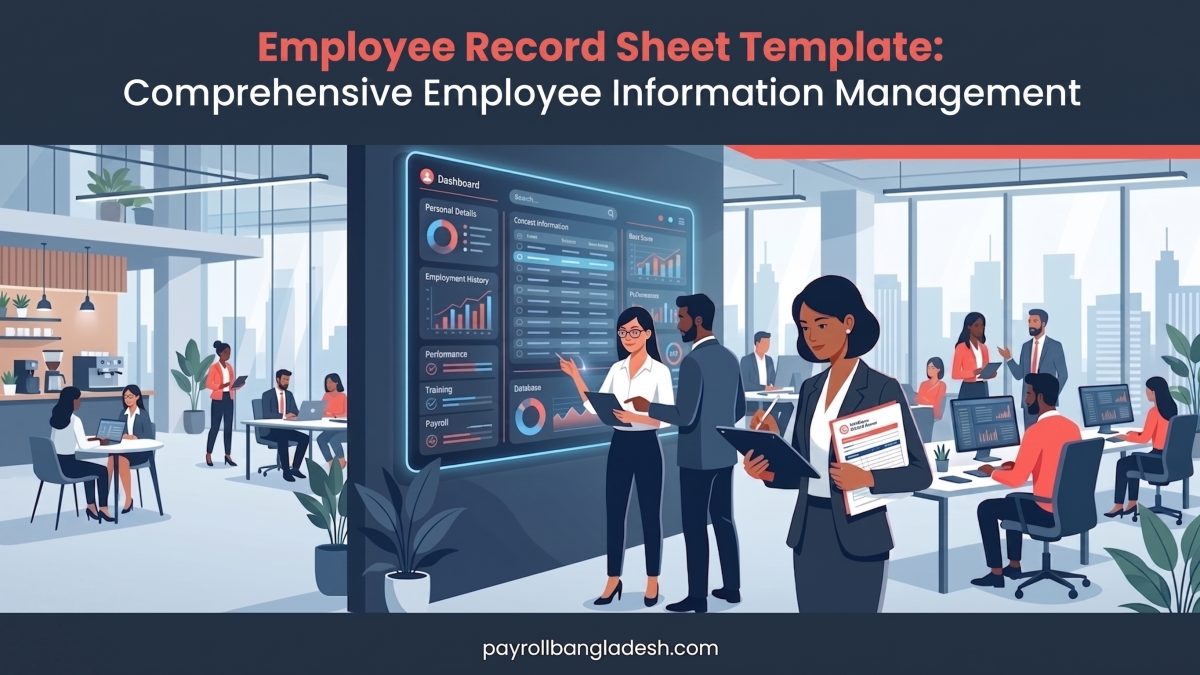
Employee Record Sheet Template for Systematic HR & Compliance Management
Maintaining accurate, structured employee records is a vital operational foundation for any enterprise operating in Bangladesh. An airtight Employee Record Sheet Template centralizes personal identification data, employment contract terms, statutory tax details, and payroll bank information into a single standardized master file. Beyond streamlining daily HR administration, systematic record management ensures absolute compliance with Department of Inspection for Factories and Establishments (DIFE) mandates and National Board of Revenue (NBR) audit requirements.
The Strategic Importance of Standardized Employee Records
As organizations grow across commercial hubs in Dhaka, Chittagong, and industrial zones nationwide, managing employee files through disconnected spreadsheets or paper folders leads to data fragmentation, security risks, and administrative friction.
To streamline these operational requirements, modern enterprises often rely on payroll process outsourcing for guaranteed compliance.
Missing National ID (NID) numbers, incorrect tax identification (e-TIN) records, or unverified bank account details can cause severe payroll processing delays and trigger regulatory non-compliance fines.
Under the Bangladesh Labour Act 2006 (Section 9 and Labour Rules Form 4), employers are legally obligated to maintain an official Service Book and register of workers for every employee.
Deploying a standardized digital Employee Record Sheet Template guarantees that all required personal, financial, and statutory parameters are captured during candidate onboarding and updated continuously.
Five Essential Modules of an Enterprise Employee Record Sheet
1. Personal ID & NID Verification Data
Full legal name, National ID (NID)/Smart Card number, passport details, father’s/mother’s name, date of birth, and permanent/present addresses.
2. Employment & Designation Details
Employee ID number, department, job title, date of joining, probation period end date, employment status (full-time/contract), and reporting manager.
3. Payroll & Banking Information
Gross monthly salary, basic wage breakdown, BEFTN/NPSB bank account number, bank name, branch routing number, and Mobile Financial Services (MFS) details.
To streamline these operational requirements, modern enterprises often rely on Employer of Record (EOR) services for guaranteed compliance.
4. Statutory Tax & Provident Fund Balances
12-digit e-TIN tax number, tax circle/zone, monthly TDS deduction category, Provident Fund (PF) account membership number, and nominee designations.
5. Emergency Contacts & Medical Fitness Logs
Primary and secondary emergency contact details, relationship, mobile numbers, blood group, medical fitness certificates, and allergy logs.
Expatriate & Foreign Employee Record Sheet Requirements
When employing foreign nationals in Bangladesh, record sheets must incorporate dedicated fields for Bangladesh Investment Development Authority (BIDA) work permits.
Tracking security clearance dates from Special Branch (SB) and NSI, A3/PI visa validity windows, and annual foreign tax clearance certificates ensures complete regulatory compliance.
Employee Self-Service (ESS) Portals & Data Accuracy
Modernizing record keeping through Employee Self-Service (ESS) portals allows staff to update present address changes, emergency contact numbers, and dependent details directly.
Implementing automated HR approval workflows prevents unauthorized edits while eliminating manual data entry burdens for HR teams.
Service Book Compliance Under Section 9 of Bangladesh Labour Act
In Bangladesh, keeping an official Service Book for workers is mandated by Section 9 of the Labour Act 2006.
To streamline these operational requirements, modern enterprises often rely on HR outsourcing solutions for guaranteed compliance.
The Service Book must record the employee’s photograph, thumb impression, basic wages, leave history, disciplinary record, and annual wage increments signed by both employee and employer.
Failure to present updated Service Books during inspection by DIFE officers can result in administrative fines and statutory compliance citations.
Using a digital Employee Record Sheet Template that maps 1-to-1 with statutory Form 4 requirements ensures seamless audit readiness at all times.
Data Privacy & Access Control Protection for Employee Records
Employee records contain highly sensitive personally identifiable information (PII), medical histories, and banking credentials.
Under the Information and Communication Technology (ICT) Act 2006 and global data protection standards (GDPR/ISO 27001), companies must restrict record access using role-based permissions.
Ensuring that only authorized HR and payroll personnel can view full employee master files prevents identity theft, data leaks, and unauthorized salary disclosures.
Manual Paper Recordkeeping vs. Digital Cloud Employee Database Matrix
Comparing traditional paper-based employee records with automated cloud record sheets:
To streamline these operational requirements, modern enterprises often rely on outsourcing HR with PEO services for guaranteed compliance.
| Recordkeeping Aspect | Manual Paper / Folder System | Digital Cloud Employee Record Sheet |
|---|---|---|
| Data Retrieval Speed | Slow manual filing search; high risk of misplaced physical documents. | Instant digital search by Employee ID, NID, or Department. |
| Statutory Audit Readiness | High vulnerability during DIFE/NBR inspections due to incomplete files. | 100% audit compliant with automated Form 4 & e-TIN tracking. |
| Data Security & Access Control | Physical filing cabinets vulnerable to theft, fire, and unauthorized viewing. | AES-256 encryption, role-based access control & audit trail logs. |
| Payroll Integration | Manual re-entry of bank details; frequent typos in account numbers. | Seamless automated export to BEFTN payroll disbursement systems. |
The 5-Step Employee Record Sheet Implementation Roadmap
Implementing a systematic employee information management system follows a 5-step workflow:
Existing HR Data Audit & Gap Analysis
Reviewing current employee files to identify missing NIDs, e-TINs, or bank account details.
Customizing the Employee Record Template
Standardizing data fields aligned with Bangladesh Labour Law Form 4 and internal reporting needs.
Digitizing Physical Records & Uploading
Scanning NIDs, certificates, and employment contracts into a secure cloud document repository.
Configuring Role-Based Security Permissions
Granting restricted data access to line managers while locking financial PII to authorized HR staff.
Annual Record Reviews & Purging Schedules
Conducting annual data validation updates and archiving former employee records per statutory retention rules.
To discover how our managed HR solutions streamline employee record management and statutory compliance, explore our Employer of Record (EOR) services in Bangladesh.
To streamline these operational requirements, modern enterprises often rely on EOR for rapid business growth for guaranteed compliance.
Case Study: Manufacturing Conglomerate Digitizes 1,200 Worker Files
The Challenge: An industrial manufacturer with 1,200 factory workers faced severe penalties during a DIFE labor inspection due to incomplete paper Service Books and missing NID records.
The Solution: Deploying Payroll Bangladesh’s digital Employee Record Sheet system centralized all 1,200 worker files within 14 days, achieving 100% DIFE compliance and cutting monthly HR record processing time by 80%.
Frequently Asked Questions About Employee Record Management
What documents must be attached to an employee’s master record sheet in Bangladesh?
Master record files should include a copy of the National ID (NID), passport photographs, signed employment contract, educational certificates, 12-digit e-TIN tax certificate, and bank details.
How long must employers retain employee record files after resignation or termination?
Under Bangladesh statutory guidelines and NBR tax audit rules, employers should retain former employee records and tax deduction proofs for a minimum of 3 to 5 years following termination.
Can digital employee record sheets replace physical Service Books?
Digital employee record systems streamline daily data tracking and can generate official Service Book prints that comply fully with Section 9 of the Bangladesh Labour Act 2006.
Modernize Your Enterprise Employee Records Management Today
Access compliant Employee Record Sheet templates and automate your statutory HR recordkeeping with our expert advisory team.