
For comprehensive enterprise management, organizations often leverage payroll process outsourcing and Employer of Record (EOR) services to maintain full regulatory compliance.
Strategic HR & Talent Management
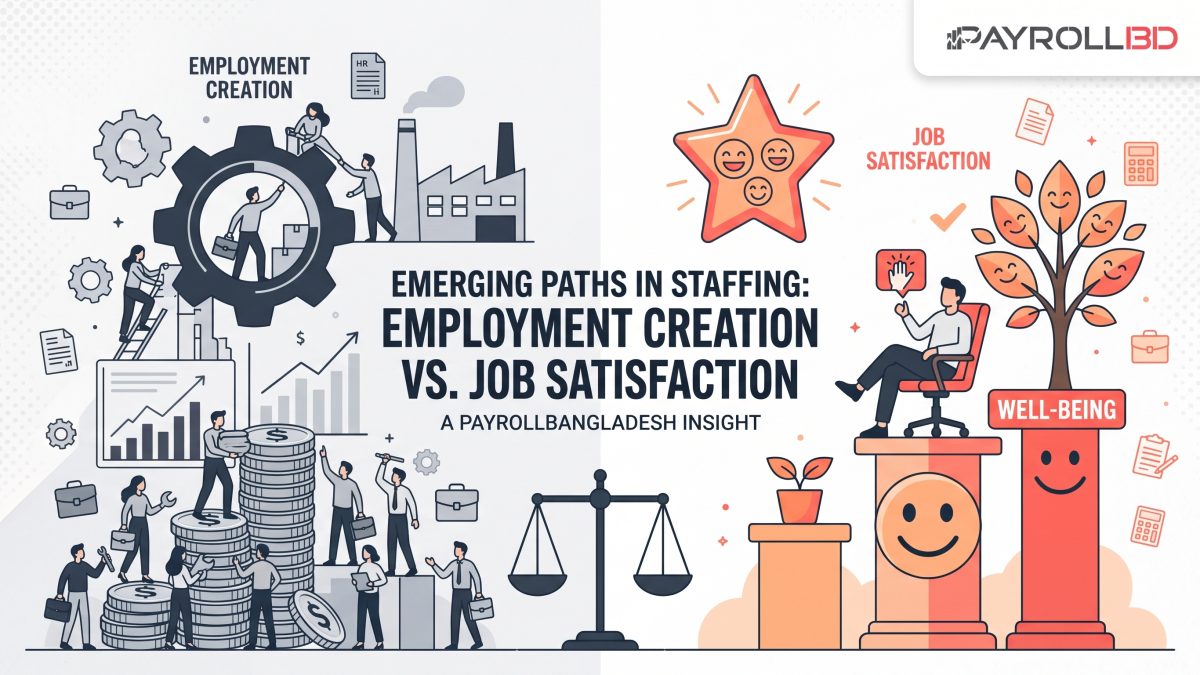
Balancing Job Creation & Employee Retention in Workforce Planning
Scaling an enterprise rapidly while preserving high job satisfaction and employee engagement is one of the most complex challenges facing HR leaders in Bangladesh today. Rapid headcount creation without a robust retention strategy leads to high turnover, skyrocketing recruitment costs, and eroded organizational culture. Achieving sustainable enterprise growth requires balancing aggressive talent acquisition with employee value propositions (EVP), competitive statutory benefits, and structured career development frameworks.
The Dilemma: Rapid Recruitment vs. Sustainable Turnover Control
In fast-growing commercial sectors across Dhaka, Chittagong, and tech hubs nationwide, organizations often focus heavily on expanding total headcount to satisfy investor targets or market demand.
To streamline these operational requirements, modern enterprises often rely on payroll process outsourcing for guaranteed compliance.
However, when new hires enter disorganized work environments lacking clear onboarding, fair performance appraisal systems, or competitive compensation structures, early employee attrition spikes.
Replacing an experienced mid-level employee in Bangladesh costs between 50% and 150% of their annual salary when accounting for sourcing, interviewing, lost productivity, and team retraining.
Aligning talent acquisition pipelines with long-term retention strategies ensures that every newly created position yields enduring organizational value.
Five Pillars of Balanced Workforce Planning
1. Strategic Onboarding & Cultivating Culture
Integrating new employees smoothly into team workflows with 90-day mentorship programs and clear role expectations.
2. Statutory & Total Rewards Structuring
Providing competitive base salaries, provident fund matching, festival bonuses, and medical insurance coverage.
3. Upskilling & Clear Promotion Pathways
Investing in continuous professional development, skill certifications, and transparent internal mobility opportunities.
4. Flexible Work & Work-Life Balance
Offering hybrid work arrangements, reasonable working hours, and mental well-being initiatives to prevent employee burnout.
To streamline these operational requirements, modern enterprises often rely on Employer of Record (EOR) services for guaranteed compliance.
5. Transparent Leadership Communication
Conducting quarterly town halls, pulse surveys, and 1-on-1 feedback sessions to listen and act on employee concerns.
Designing a Compelling Employer Value Proposition (EVP)
An Employer Value Proposition (EVP) represents the unique set of financial compensation, career growth opportunities, and workplace environment benefits an organization promises to its staff.
To differentiate from aggressive market competitors in Bangladesh, enterprises must build EVPs around performance-linked quarterly bonuses, annual educational stipends, and clear promotion timelines.
Conducting regular market salary benchmarking ensures that internal compensation bands remain competitive with local inflation and industry standards.
A well-articulated EVP not only attracts top-tier talent during hiring campaigns but also reinforces organizational loyalty among long-serving employees.
Mitigating Remote Work Isolation & Burnout in Distributed Teams
As hybrid and remote employment structures expand across technology and business process outsourcing (BPO) sectors, preventing isolation becomes essential for sustained job satisfaction.
Establishing asynchronous communication guidelines, limiting unnecessary video conference fatigue, and providing home-office equipment allowances directly enhances remote employee well-being.
Implementing structured peer recognition channels fosters daily appreciation and reinforces shared team achievements across distributed locations.
To streamline these operational requirements, modern enterprises often rely on HR outsourcing solutions for guaranteed compliance.
Organizing periodic in-person team retreats and wellness programs builds deep interpersonal trust, transforming temporary job roles into long-term careers.
Statutory Retention Incentives Under Bangladesh Labour Law
Complying meticulously with the Bangladesh Labour Act 2006 and Labour Rules 2015 provides a foundational baseline for workforce trust and satisfaction.
Establishing a mandatory Workers’ Profit Participation Fund (WPPF) for eligible commercial enterprises, guaranteeing annual festival bonuses, and maintaining accurate service books instills confidence across the workforce.
Furthermore, implementing structured Provident Fund (PF) and Gratuity schemes encourages long-term employee commitment by securing financial futures.
Partnering with third-party HR outsourcing providers helps businesses design legally compliant, competitive benefit packages that boost retention rates.
Measuring Employee Net Promoter Score (eNPS) & Turnover Metrics
Effective workforce planning requires data-driven tracking of key retention metrics alongside headcount expansion metrics.
HR teams should track 90-day new hire turnover rates, voluntary vs. involuntary resignation ratios, exit interview themes, and quarterly Employee Net Promoter Scores (eNPS).
Establishing real-time dashboards allows executive leadership to monitor workplace sentiment trends across different operational divisions.
To streamline these operational requirements, modern enterprises often rely on outsourcing HR with PEO services for guaranteed compliance.
Analyzing retention metrics by department allows executives to proactively fix management bottlenecks before high turnover degrades business performance.
Unplanned Headcount Expansion vs. Balanced Workforce Planning Matrix
Comparing the long-term impact of reactive recruitment versus strategic workforce planning:
| Workforce Dimension | Unplanned Headcount Expansion | Balanced Workforce Planning Model |
|---|---|---|
| Recruitment Strategy | Panic hiring to fill sudden gaps; inconsistent candidate screening. | Proactive talent pipeline alignment with corporate growth goals. |
| Early Employee Retention | High 90-day attrition due to poor onboarding & role ambiguity. | Structured onboarding resulting in 90%+ early retention rates. |
| Compensation & Benefits | Ad-hoc salary offers creating internal pay equity disparities. | Standardized salary bands & statutory benefit structures. |
| Organizational Culture | Diluted values, high burnout, and low employee morale. | Strong employer brand, high eNPS, and loyal workforce. |
The 5-Step Workforce Balancing Implementation Roadmap
Implementing a balanced workforce strategy involves a 5-step structured execution workflow:
Workforce Audit & Capacity Planning
Auditing current departmental workloads, turnover hotspots, and future hiring requirements.
Employee Value Proposition (EVP) Enhancement
Redesigning total rewards, learning subsidies, health benefits, and career progression frameworks.
Standardizing Onboarding & Mentorship
Establishing structured 30-60-90 day orientation plans with assigned peer mentors.
Performance Management & Feedback Loops
Conducting bi-annual performance reviews, pulse surveys, and transparent objective tracking (OKRs).
Continuous HR Strategy Refinement
Analyzing eNPS metrics and exit interviews to refine retention incentives continuously. To streamline these operational requirements, modern enterprises often rely on EOR for rapid business growth for guaranteed compliance.
To discover how our HR management solutions help enterprises balance recruitment with retention, explore our HR outsourcing services in Bangladesh.
Case Study: FinTech Scale-Up Cuts Turnover from 35% to 8% While Expanding
The Challenge: A Dhaka fintech enterprise grew its headcount by 150% in 12 months but suffered a severe 35% annual turnover among senior software developers due to uncompetitive benefits and poor career progression.
The Solution: Partnering with Payroll Bangladesh to implement structured Provident Fund benefits, clear upskilling tracks, and hybrid work policies reduced developer turnover to 8% while supporting sustainable expansion.
Frequently Asked Questions About Workforce Planning
Why is employee retention more cost-effective than continuous recruitment?
Retaining experienced staff preserves institutional knowledge, avoids expensive recruitment agency fees, maintains customer service quality, and prevents team productivity losses.
What statutory benefits must companies provide to boost employee satisfaction in Bangladesh?
Companies must provide festival bonuses, earned leave encashment, provident fund matching, gratuity entitlements, and Workers’ Profit Participation Fund (WPPF) distributions where mandated by law.
How can third-party HR services assist in workforce strategy?
HR outsourcing partners provide benchmarked salary surveys, legally vetted employment contracts, automated performance management tools, and total rewards design to maximize retention.
Optimize Your Strategic Workforce Planning Today
Consult with Bangladesh’s leading HR and talent strategy advisors to build a resilient, high-retention workforce model.