

Will Your Global Contract Hold Here?
Contract and policy localization is the work of rewriting a global employment contract so it holds under local law. PayrollBangladesh reviews your contracts, offer letters and HR policies against the Bangladesh Labour Act 2006, rewrites the clauses that fail here, and returns ready-to-sign versions in English and Bangla.
Global template
Bangladesh-ready version
Termination: at will, without notice with notice and dues under the Labour Act 2006
Leave: 15 days PTO casual, sick, earned and festival leave
Non-compete: 24 months worldwide confidentiality and IP terms that can be enforced
Language: English only English and Bangla
What is contract and policy localization?
It is adapting a company’s standard employment contract, offer letter and HR policies so they comply with Bangladesh law and local practice. PayrollBangladesh checks each document against the Bangladesh Labour Act 2006 and Labour Rules 2015, fixes clauses on notice, leave, working hours, probation and termination, and delivers bilingual English and Bangla versions ready for signing.
Which Contracts Do We Localize?
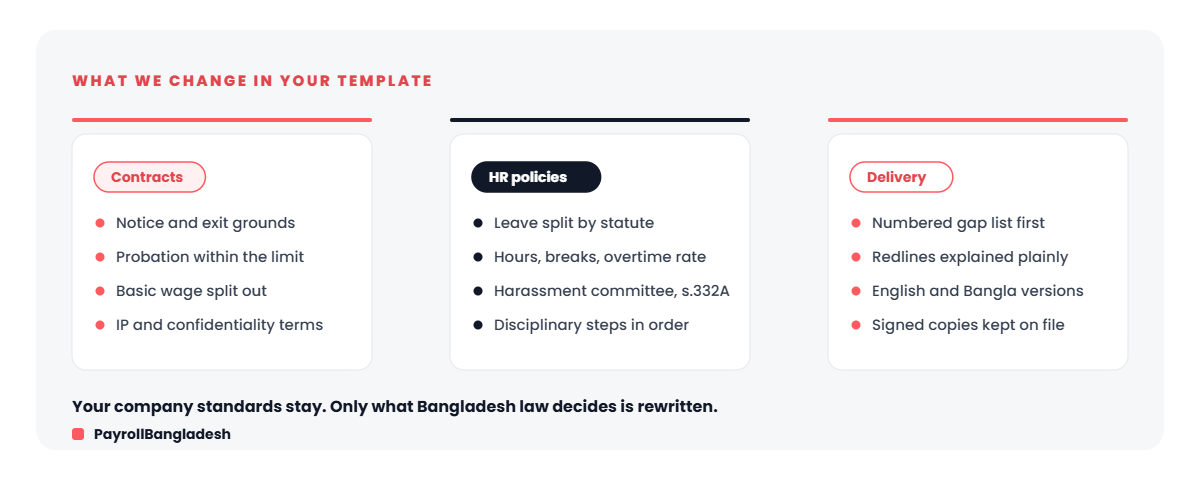
Send us your global versions and we return documents a worker in Bangladesh can sign. Your company standards stay as written; only the clauses local law decides are rewritten. These five sit at the core of every hire, and we localize them as one set.
Employment contract review
We compare your template with the Bangladesh Labour Act 2006 and mark every clause that will not hold. Notice periods, probation limits, leave entitlements and termination grounds are rewritten to the statutory position, while your pay structure, job levels and group standards stay exactly as your head office wrote them. If we also act as your Employer of Record in Bangladesh, the localized contract is the one we issue on hire.
Offer letter localization
The offer letter states salary, allowances, benefits, start date and reporting line in the format candidates here expect. We separate gross pay into basic wage and allowances, because provident fund and gratuity are both calculated on basic wage rather than on the total package.
Appointment letter drafting
Every worker in Bangladesh must receive a written appointment letter and a photo identity card on hiring. We draft the letter so it names the job, the wage, the category of worker and the main terms, and we prepare the identity card format alongside it.
NDA and IP terms
Confidentiality and intellectual property assignment survive here where a broad non-compete does not. We draft obligations that bind during employment and after it ends, covering client lists, source code, designs and commercial terms, and we tie each one to a definition a local court can read.
Employee handbook adaptation
Your global handbook keeps its structure, tone and company values. We replace the sections that assume another jurisdiction, add the policies Bangladesh law requires, and flag anything in the original that would create an unintended contractual promise if an employee relied on it.
Which HR Policies Do We Localize?
Policies are where global templates fail most often, because each one quietly assumes a jurisdiction. We rewrite these five against the Labour Act 2006 and the Labour Rules 2015, and we mark which clauses are statutory minimums rather than choices your company gets to make.
Leave policy rewrite
A single paid-time-off bucket does not work here. We split leave into casual leave of 10 days under section 115, sick leave of 14 days under section 116, earned leave, 13 festival holidays under section 118 and maternity benefit of 120 days under section 46.
Working hours and overtime
Section 100 sets the normal working day at eight hours, extendable to ten, and section 102 sets the weekly limit at 48 hours. Section 108 requires overtime at twice the ordinary rate. We write hours, rest breaks, shift patterns and the overtime formula into the policy.
Harassment complaint policy
Section 332A requires every employer to form a five-member committee to resolve complaints of discrimination, violence and harassment. A woman heads it, women hold the majority, and two members come from an organisation working on gender and sexual abuse. We draft the policy and the complaint route.
Disciplinary procedure steps
Misconduct cases follow a fixed sequence of written charge, explanation, inquiry and a decision recorded in writing. We set out who issues each document, how long the worker has to respond, and how suspension during inquiry is handled, so a dismissal can survive scrutiny later.
Exit and termination policy
Resignation, retrenchment, discharge and dismissal each carry their own notice and payment rules. We write the grounds, the notice period, the compensation formula under section 27(4) and the 30 working day settlement deadline under section 123(2) into one policy your managers can follow. Gratuity falling due at exit is run by our provident fund and gratuity administration service.
Which Clauses Fail in Bangladesh?
These are the clauses we change most often when a foreign template meets Bangladesh law. Each one is enforceable at home and unenforceable, or simply wrong, once the work happens here.
| Clause | Problem in Bangladesh | Localized approach |
|---|---|---|
| At-will termination | Employment cannot end without notice or cause | Notice, grounds and dues written under the Act |
| Single PTO bucket | The Act sets separate leave types with separate rules | Casual, sick, earned, festival and maternity leave listed apart |
| Open-ended working hours | Daily and weekly limits apply and overtime is paid double | Hours, breaks and the overtime formula stated plainly |
What Replaces an Unenforceable Clause?
Removing a clause is not enough on its own. Each of these gets a replacement that does the same commercial job and survives a local court or a labour inspection.
| Clause | Problem in Bangladesh | Localized approach |
|---|---|---|
| Broad non-compete | Section 27 of the Contract Act 1872 voids restraints on lawful profession | Confidentiality, non-solicitation and IP assignment instead |
| Long probation | The Act limits how long probation may run | Probation set within the legal limit for the role |
| Foreign governing law | Bangladesh labour law still applies to work done here | Bangladesh law governs the employment terms |
How Does Localization Work?
Four stages take you from a global template to signed local documents. You approve at each stage. Nothing reaches your staff until you have seen it. Most sets move through all four stages in one cycle. You can also stop after the gap list, if all you want right now is to know where you stand.
Gap review against the Act
We read each document against the Labour Act 2006 and the Labour Rules 2015 and return a numbered gap list. Every entry names the clause, the section it conflicts with and what the document would have to say instead, so your legal team can see the reasoning before anything is changed.
Redline and plain explanation
We redline the clauses in your own file and explain each change in plain English beside it. Where a clause is a commercial choice rather than a statutory minimum we say so, and we leave the decision with you rather than rewriting your company position.
Bilingual versions prepared
Final versions are prepared in English and Bangla and checked against each other clause by clause. The two texts are set side by side so a reviewer who reads only one language can still see that nothing was added, dropped or softened in translation.
Sign-off and issue
You approve the final set. We help you issue the documents to staff, collect signatures, and keep signed copies filed against each employee record so the set is ready if the Department of Inspection for Factories and Establishments asks to see it.
Which Hours and Leave Rules Apply?
These are the statutory floors every contract and policy must respect. Your company can be more generous than the Act; it cannot write less.
| Term | What the law requires | Source |
|---|---|---|
| Working day | Eight hours normally, ten hours at most | Labour Act, s. 100 |
| Working week | Forty-eight hours | Labour Act, s. 102 |
| Overtime pay | Twice the ordinary rate of wages | Labour Act, s. 108 |
| Casual leave | Ten days a year on full wages | Labour Act, s. 115 |
| Sick leave | Fourteen days a year on full wages | Labour Act, s. 116 |
Which Pay and Exit Rules Apply?
Pay timing and exit money are where disputes start, and where an inspector looks first. Each figure reflects the Act as it stands after the 2026 amendment.
| Term | What the law requires | Source |
|---|---|---|
| Festival holidays | Thirteen paid days a year, raised from eleven | Labour Act, s. 118, amended 2026 |
| Maternity benefit | Sixty days before and sixty days after delivery | Labour Act, s. 46, amended 2026 |
| Monthly wages | Paid by the seventh working day after the wage period | Labour Act, s. 123(1) |
| Final dues | Paid within thirty working days of employment ending | Labour Act, s. 123(2) |
Why Deliver in English and Bangla?
Every localized document comes in two versions, so your head office and your team in Bangladesh read the same terms.
- English version for legal review and group records
- Bangla version so every employee understands their terms
- Both checked to say the same thing, clause by clause
EN + বাংলা
Why the Bangla version matters
Clear terms in the language staff read reduce disputes. They also help at a labour inspection. And they make a policy far easier to enforce. A worker who signed a document he could not read is a weak position to defend. If you employ through our Employer of Record service, localized contracts are part of onboarding.
Questions We Are Asked Most
These are the questions foreign employers ask us most often before sending their templates. Each answer states the position first, then the section of the Act it rests on. If your question is not here, send the document and we will answer against your actual wording rather than in general terms.
Can we use our global contract here?
Usually not as it is. Clauses on at-will termination, leave, working hours, probation and non-competes often conflict with the Bangladesh Labour Act 2006 or the Contract Act 1872. We keep your standard structure and change only what local law requires.
Must contracts be in Bangla?
Staff must be able to understand their terms, so we deliver every contract and policy in both English and Bangla, checked to match clause by clause. The English version is what your group legal team reviews and files. The Bangla version is what the employee actually reads before signing, and it is the one that carries weight if a worker later says a term was never explained to them.
Are non-compete clauses enforceable?
Generally not. Section 27 of the Contract Act 1872 makes agreements that restrain someone from a lawful profession void, with narrow exceptions. We use confidentiality, non-solicitation and intellectual property assignment terms instead, which do hold here. Those three cover most of what the non-compete was protecting anyway: client relationships, commercial terms, and anything your team built while employed.
Which leave types must we include?
Casual leave of 10 days under section 115 and sick leave of 14 days under section 116, both on full wages, plus earned leave, 13 paid festival holidays under section 118 and maternity benefit of 120 days under section 46. A single pooled allowance does not satisfy these, because each type carries its own rules on carry-forward and on the proof an employer may ask for.
What is an appointment letter?
A written letter every worker must receive when hired, setting out the job, the wages and the main terms, along with a photo identity card. We prepare it as part of the contract set rather than as an afterthought, because it is the document an inspector asks for first and the one most foreign employers have never issued.
Do we need a harassment policy?
Yes. Section 332A, inserted by the Bangladesh Labour (Amendment) Act 2026, requires every employer to form a committee that resolves complaints of discrimination, violence and harassment. It has five members, a woman chairs it, women hold the majority, and two members come from an organisation working on gender and sexual abuse. We draft the policy, the complaint route and the committee terms of reference.
Can you localize for an INGO?
Yes. We localize contracts and policies for subsidiary and INGO country offices, branch and liaison offices, and keep them in line with your group or headquarters policies. Where a donor agreement or a group code sets a stricter term than Bangladesh law, we keep the stricter term and mark it clearly, so nobody later mistakes a company promise for a statutory minimum.
Is this legal advice?
No. We are an HR and payroll provider, not a law firm. Our localization follows the Labour Act 2006, the Labour Rules 2015 and local practice, and we tell you plainly when a point needs a licensed practitioner. For a binding opinion, or for anything already in dispute, take advice from a lawyer admitted in Bangladesh before you issue the document.
Send Us Your Global Templates
Share your contract, offer letter and handbook. We will return a gap list and a quote for Bangladesh-ready versions in English and Bangla.
PayrollBangladesh · Rupayan Shopping Square, Suite 610, Bashundhara R/A, Dhaka 1229 · +880-1711-990010 · info@payrollbangladesh.com
Reviewed by Romana Akter Shila, Chief Executive Officer, PayrollBangladesh, 8 years in EOR and payroll operations. This page is general information, not legal advice.