

Be ready on the day
Labour inspection readiness is having every register, record, notice and committee that Bangladesh labour law requires in place and current before an inspector arrives. PayrollBangladesh audits your registers, wages, leave and committees against the Labour Act 2006 as amended in 2026, fixes the gaps, and supports you on the day DIFE visits.
- Register of workersReady
- Appointment letters and ID cardsReady
- Wage and overtime recordsReady
- Leave recordsFix
- Harassment complaints committeeMissing
Illustration of the report you receive after our audit.
What is labour inspection readiness?
It means having every register, record, notice and committee that Bangladesh labour law requires in place and up to date, so your workplace can pass an inspection by DIFE at any time. PayrollBangladesh runs a mock inspection, lists the gaps, fixes the records with you and keeps them current every month.
What Does a Labour Inspector Check?
DIFE inspectors can visit factories, offices and other establishments, examine records and speak to workers. These are the areas they look at most. An inspection is a document exercise before it is anything else. Most findings are recorded because a register was missing or out of date, not because of what the inspector saw on the floor.
Employment records on file
Every worker on your site should be traceable on paper before the inspector asks. The register of workers must be kept ready for inspection at all working times under section 9 of the Labour Act.
- Register of workers
- Appointment letters and ID cards
- Service books
Wages and overtime
Pay records are where most findings start. Wages fall due within seven working days of the wage period ending, and overtime is paid at twice the ordinary rate of basic wage and dearness allowance.
- Wage registers and payslips
- Payment within seven working days
- Overtime at twice the ordinary rate
Hours and leave
Leave entitlements are fixed by statute, not by company policy. Casual, sick, annual and festival leave each sit in their own section of the Labour Act, and recorded balances must reconcile to what staff actually took.
- Attendance and working hours
- Leave records and balances
- Festival holidays and maternity benefit
Committees you must form
Missing committees are among the most common inspection findings, and they cannot be created retrospectively. Which ones you need turns on how many workers you ordinarily employ, not on which industry you are in.
- Safety committee, where required
- Participation committee, where required
- Harassment complaints committee
Health, safety and welfare
Inspectors look at the physical workplace as well as the paperwork. Welfare provisions sit in Chapter VIII of the Labour Act, and the safety committee requirement there was rewritten by the 2026 amendment.
- Fire safety and first aid
- Drinking water and toilets
- Safety training records
Terminations and settlements
Exits attract scrutiny because the money is final and the deadline is short. All wages due on termination fall due within thirty working days of employment ending, under section 123(2) of the Labour Act.
- Notice and termination records
- Final settlements paid on time
- Gratuity and other dues
How Does Our Readiness Audit Work?
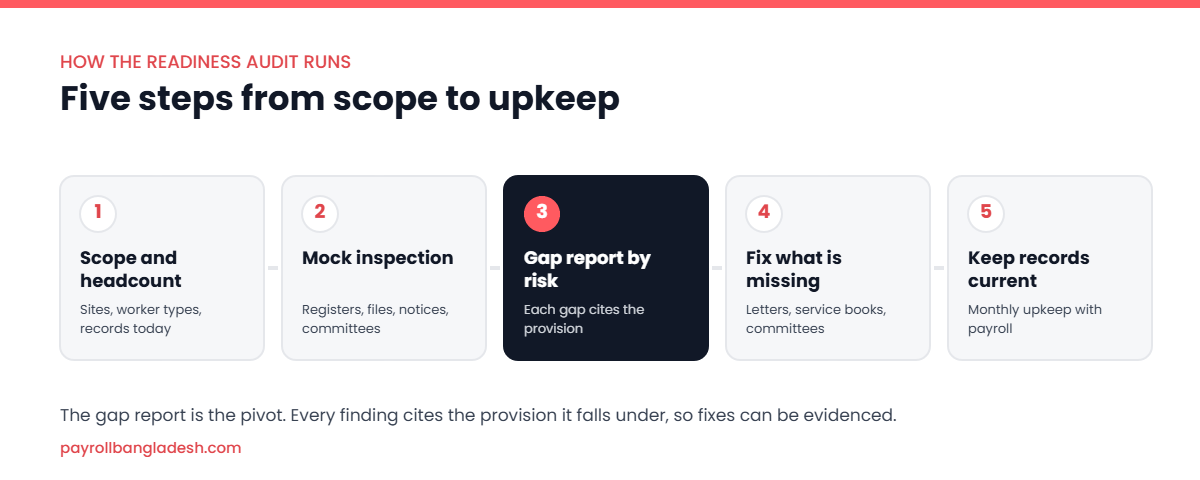
A mock inspection that finds the problems before an inspector does. The audit runs the same way every time, so the gap report is comparable from one month to the next. We work from your actual records rather than a questionnaire, because an inspector will do the same.
-
1
Scope and headcount
Sites, headcount, worker types and the records you keep today. We confirm how many workers you ordinarily employ at each site, because the committee and register duties turn on that number rather than on your industry. Casual, badli and apprentice staff are counted separately, since some record duties exclude them.
-
2
Run a mock inspection
We check registers, files, notices and committees as an inspector would. That means opening the register of workers, pulling sample service books, and checking that wage and overtime entries reconcile to what was actually paid. Notices on display are checked too.
-
3
Gap report by risk
A written list of gaps, ranked by risk, with the fix for each one. Each gap cites the provision it falls under, so your team can see why it matters rather than taking our word for it. Items carrying a statutory deadline are listed first.
-
4
Fix what is missing
We update records, draft missing letters and help set up committees. Appointment letters and identity cards are issued where workers have none, service books are opened for staff entitled to one, and committee minutes are started properly rather than backdated.
-
5
Keep records current
Monthly upkeep so you stay ready, not just ready once. New joiners are added to the register in the month they start, leave balances are rolled forward, and committee meetings are minuted as they happen. Readiness decays quickly without this.
Which Records Can an Inspector Ask For?
The core documents we check and keep up to date for you. The first table lists the records that must exist for every worker. The second lists the duties that carry a fixed statutory deadline, which are the ones most often missed.
Records you must keep
| Record or requirement | What it must show | Reference |
|---|---|---|
| Appointment letter and ID card | No worker may be employed without one, and every worker gets a photo identity card | Labour Act, s. 5 |
| Service book | Kept for each worker, except certain casual and temporary staff | Labour Act, s. 6 |
| Register of workers | Kept at the establishment and available to the inspector | Labour Act, s. 9 |
| Overtime records | Paid at twice the ordinary rate of basic wage and dearness allowance; piece-rate workers are excluded | Labour Act, s. 108 |
| Leave records | Casual, sick, earned and festival leave taken and due | Labour Act, ss. 115–118 |
Duties with a deadline
| Duty | What the law requires | Reference |
|---|---|---|
| Wage payment records | Wages paid before the end of the seventh working day after the wage period | Labour Act, s. 123(1) |
| Final settlement records | All dues paid within 30 working days after employment ends | Labour Act, s. 123(2) |
| Safety committee | Required in every establishment with 50 or more workers, and it must meet regularly | Labour Act, s. 90A; Rules 2015 |
| Harassment complaints committee | Handles complaints of discrimination, violence and harassment | Labour (Amendment) Act 2026 |
Based on the Bangladesh Labour Act 2006, as amended by the Bangladesh Labour (Amendment) Act 2026 (Act No. 43 of 2026), and the Labour Rules 2015. Some provisions of the 2026 Act still await implementing rules.
Which Committees Does the Law Require?
Missing committees are one of the most common findings. We help you set them up and keep their minutes. A committee that exists only on paper is treated much the same as no committee at all, so attendance, dates and minutes matter as much as the constitution itself.
Safety committee duties
Formed in every establishment employing fifty or more workers, in the manner the Labour Rules prescribe. The Rules also set how often it must meet and who sits on it.
Labour Act, s. 90A; Labour Rules 2015
Participation committee duties
Worker and management representatives who meet regularly on workplace issues and productivity. Required in every establishment ordinarily employing fifty or more workers. The worker representatives may not be fewer in number than the employer’s representatives on the same committee.
Labour Act, s. 205
Harassment committee duties
A committee to receive and deal with complaints of discrimination, violence and harassment at work. This obligation came in with the 2026 amendment, so many employers have not yet constituted one. Some provisions still await implementing rules, and we will tell you which parts are settled.
Labour (Amendment) Act 2026
What Happens on Inspection Day?
If an inspector calls or arrives, this is how we support you. An inspection is easier to handle when someone has already decided who speaks, where the files are and what happens to the findings afterwards. These three stages are what we put in place.
Prepare before the visit
Readiness is decided long before the inspector reaches reception. The register, the files and the notices are either current or they are not, and there is no way to correct them while someone is waiting.
- Registers and files checked and up to date
- One contact person named
- Records organised by site
Support during the visit
One named person should answer, with the records in front of them. Answering from memory is how avoidable findings get recorded, so every answer we give is the one the paperwork supports.
- Documents produced quickly
- Questions answered with records
- Findings noted carefully
Close out afterwards
Findings do not end when the inspector leaves. Each one becomes an action with an owner and evidence that it was done, and the reply goes back in writing.
- Findings turned into an action plan
- Fixes made and evidenced
- Reply to the inspector prepared
Why Does Readiness Matter?
The general penalty under section 307 of the Labour Act was raised in 2026 from Tk 5,000 to between Tk 25,000 and Tk 50,000, with up to three months’ imprisonment. Most findings are avoidable with records that are kept up to date every month.
Questions We Are Asked Most
These are the questions employers ask us most often before an audit. Where a rule turns on headcount or on which instrument applies, the answer says so, because that is usually what decides whether a finding is recorded rather than waived.
Who carries out labour inspections?
The Department of Inspection for Factories and Establishments (DIFE), under the Ministry of Labour and Employment. Its inspectors check compliance with the Bangladesh Labour Act 2006 and Labour Rules 2015 in factories, offices and other establishments. DIFE sits under the Ministry of Labour and Employment, and its inspectors may enter premises, examine records and speak to workers. An inspection can follow a complaint or arrive as part of routine coverage.
What documents should we have ready?
The register of workers, appointment letters and ID cards, service books, attendance, wage, overtime and leave records, final settlement records, and the minutes of any required committees, such as the safety committee and the harassment complaints committee. Keep them together and current rather than assembling them on the day, because an inspector records what is produced at the time of the visit.
Do offices need to prepare too?
Both. The Labour Act covers shops, commercial establishments and offices as well as factories. Thresholds matter more than sector. The safety committee requirement, for example, applies to every establishment employing fifty or more workers rather than to factories alone, while records on wages, hours and leave apply widely.
When is a safety committee required?
In every establishment employing fifty or more workers, under section 90A of the Labour Act as substituted by the 2026 amendment. The committee is constituted in the manner the Labour Rules 2015 prescribe, and those rules also set who sits on it and how often it must meet.
What if an inspector finds a problem?
Usually the employer is asked to correct it within a set time. Continued or serious breaches can lead to penalties. Section 307, as substituted by the 2026 amendment, sets the general penalty at a fine of not less than Tk 25,000 and not more than Tk 50,000, or imprisonment of up to three months, or both.
What is a mock labour inspection?
A practice inspection where we check your records, notices and committees as an inspector would, then give you a written gap report with the fix for each finding. It is deliberately run the way an inspection is run, from the records rather than from a questionnaire, so the findings are the ones you would actually receive.
Can you keep records ready monthly?
Yes. Records stay current when they are updated with each payroll. Our payroll outsourcing service keeps wage, overtime and leave records up to date automatically. Records then stay current as a by-product of running payroll, instead of being reconstructed in a hurry before a visit.
Who handles inspections under an EOR?
The Employer of Record is the legal employer, so it keeps the employment records. With our Employer of Record service, we hold those records and support any inspection that involves your staff. Your own site records still matter, so we agree in advance which documents sit with us and which stay with you.
Find Your Gaps Before an Inspector Does
Tell us how many sites and workers you have. We will scope a mock inspection and send a fixed quote.
PayrollBangladesh · Rupayan Shopping Square, Suite 610, Bashundhara R/A, Dhaka 1229 · +880-1711-990010 · info@payrollbangladesh.com
Reviewed by Romana Akter Shila, Chief Executive Officer, PayrollBangladesh, 8 years in EOR and payroll operations. This page is general information, not legal advice.