

We Handle Your Fund
A provident fund is a joint savings fund where the employee and the employer each contribute every month. PayrollBangladesh administers provident funds and gratuity schemes for companies, subsidiaries and INGO country offices in Bangladesh. We deposit contributions, keep a member ledger, issue annual statements and calculate every final payment. Your trustees stay in control and see the records behind every figure.
How a provident fund is funded
Typical structure under Section 264 of the Bangladesh Labour Act 2006. Your fund rules set the exact rate.
What is a provident fund in Bangladesh?
A provident fund is a savings pot for employees. Each month the employee pays a set share of basic wage into it. Section 264 of the Bangladesh Labour Act 2006 sets that share at seven to eight per cent of basic wage. The employer pays the same amount again. A board of trustees holds and invests the money. The member receives the balance, plus returns, on leaving under the fund rules.
What is gratuity in Bangladesh?
Gratuity is a lump sum the employer pays when service ends. The Bangladesh Labour Act 2006 sets a floor of 30 days’ wages for each completed year of service. Where service runs beyond ten years, that floor rises to 45 days’ wages for each year. Many employers set a higher figure in their own policy. We calculate both and apply whichever is greater.
What do we administer for you?
We run the day-to-day work of both schemes while your board of trustees keeps every decision. That means the monthly contribution run, a ledger for each member, the annual statement cycle, the gratuity liability figure your auditor asks for, and the final calculation when someone resigns or retires. You approve. We execute and hand you the records.
Provident fund administration
Monthly
- Contribution processing: employee and employer shares calculated through payroll and deposited to the fund account
- Member ledgers: an individual account for each member, updated every month
- Profit allocation: investment returns shared across members at year end
- Loans and withdrawals: handled under your fund rules, with trustee approval
- Annual statements: a clear balance statement for every member
- Final payouts: balances calculated and paid when members leave
Gratuity scheme administration
Yearly
- Policy set-up: a gratuity policy in line with the Labour Act and your terms
- Liability calculation: the amount you owe each employee, updated every year
- Fund management support: records for an approved gratuity fund, if you have one
- Exit calculations: gratuity or resignation benefit worked out for each leaver
- Final settlement: paid with other dues within 30 working days of exit
- Audit files: calculations and approvals kept for auditors and tax reviews
Which rules apply in Bangladesh?
Three sources govern a Bangladesh fund. The Labour Act 2006 sets the provident fund structure and the gratuity floor. The Labour Rules 2015 set what the appointment letter must state. The Income Tax Act 2023 decides whether a fund is recognised for tax. The table lists each rule we build into a scheme, with the section it comes from.
Provident fund rules
| Item | What applies | Source |
|---|---|---|
| PF contribution | Employee pays 7–8% of basic wage; the employer contributes an equal amount | Labour Act 2006, s. 264 |
| PF membership | Workers with at least one year of service | Labour Act 2006, s. 264 |
| When a PF is required | Mandatory at 100 or more permanent workers on a two-thirds written request | Labour Act 2006, s. 264, as amended |
| Pension alternative | Employers may enrol staff who ask in the government’s Progoti universal pension scheme instead | Labour Act 2006, s. 264, as amended |
Gratuity and payment rules
| Item | What applies | Source |
|---|---|---|
| Gratuity amount | At least 30 days’ wages per completed year; 45 days’ after ten years | Labour Act 2006, s. 2(10) |
| Resignation benefit | 7 days’ wages at 3 years, 15 days’ under 10, 30 days’ or gratuity | Labour Act 2006, s. 27(4), as amended in 2026 |
| Payment deadline | All dues, including gratuity, paid within 30 working days after employment ends | Labour Act 2006, s. 123(2) |
| Tax recognition | Funds recognised or approved by the National Board of Revenue receive tax benefits | Income Tax Act 2023 |
What changed in 2026
Section 264 was rewritten. The Bangladesh Labour (Amendment) Act 2026 replaced section 264(10). An establishment with 100 or more permanent workers must now constitute a provident fund if at least two-thirds of its workers apply in writing, and it has six months from that application to do so. An employer who instead enrols interested staff in the government Progoti pension scheme, paying half of each contribution, is released from that duty.
How is gratuity calculated?
Gratuity rests on two numbers: the last monthly wage and the count of completed years. Thirty days’ wages is treated as one month. So the floor is one month’s wage for every completed year. Past ten years of service the multiplier rises to one and a half. The worked example below uses round numbers to show the arithmetic.
The gratuity formula
30 days’ wages is treated as one month’s wage, and 45 days’ wages as one and a half. Your policy decides whether “wage” means basic pay or a wider figure, and may pay more than the legal minimum.
Example at six completed years
- Last monthly wage
- Tk 40,000
- Completed years of service
- 6
- Days’ wages per year
- 30
- Minimum gratuity
- Tk 240,000
Illustration only. Actual entitlement depends on how employment ends, your policy and the wage definition used. Where your policy pays more than the statutory floor, we calculate both figures and apply the higher one.
What happens each month and year?
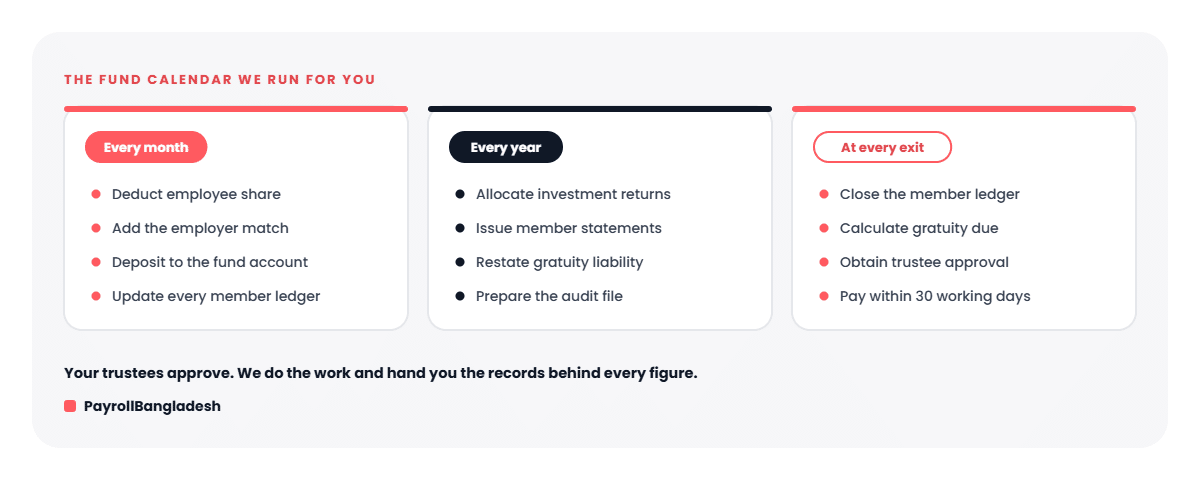
The work follows a fixed calendar agreed with your trustees. Every month we deduct, match and deposit contributions, then update each member ledger. Every year we allocate investment returns, issue member statements, restate the gratuity liability and prepare the audit file. At every exit we calculate the final balance and the gratuity, then pay inside the statutory window.
Contributions and ledgers
- Deduct employee contributions through payroll
- Calculate the employer match
- Deposit both to the fund account
- Update each member’s ledger
Contributions reach the fund account in the same cycle as salary, so the ledger, the payslip and the bank record all agree before the month closes.
Statements and valuation
- Allocate investment returns to members
- Issue member balance statements
- Update the gratuity liability
- Prepare files for the fund audit
Statements show the balance brought forward, contributions received, returns allocated and the closing figure, in a form your auditor accepts without rework.
Final exit calculations
- Calculate PF balance and any forfeiture under the rules
- Calculate gratuity or resignation benefit
- Obtain trustee approval
- Pay within 30 working days
Leavers are the step most schemes get wrong, so we reconcile the member ledger against payroll before any payment is approved and released.
How do you set up a fund?
A new scheme needs its paperwork in place before the first contribution is taken. There are four steps and we handle each one with you. The fund rules and trust deed come first, then the board of trustees, then recognition by the National Board of Revenue, then a separate bank account and ledger. The order matters for tax recognition.
Fund rules and trust deed
We draft the fund rules and trust deed covering contributions, eligibility, loans, forfeiture and payouts. The deed names the trustees and fixes how they decide. Getting the wording right at this stage avoids the amendments that delay recognition later. We work from your existing HR policy where one exists.
Board of trustees
We help you appoint trustees from management and staff and set out their duties. The board approves contributions, investments and every payout. We prepare the meeting papers and the minutes so each decision is recorded, and we keep the register of who served and when.
NBR recognition application
We prepare the application for recognition or approval by the National Board of Revenue, so the fund gets its tax benefits. Recognition decides how contributions and returns are taxed on both sides. We assemble the deed, the rules and the member list, then answer the queries that follow.
Bank account and records
A separate fund bank account and ledger system, kept apart from company money. Fund assets never sit in the operating account. We reconcile the bank balance against the member ledgers every month, so the total held always matches the sum of the individual balances.
Questions We Are Asked Most
Answers to what HR and finance teams ask us most. Each answer states the rule first, then what it means for your scheme. Where a figure comes from the Labour Act or the Income Tax Act, the section is named, so your own adviser can check it.
Is a provident fund mandatory in Bangladesh?
Not always. Section 264 of the Labour Act lets any private establishment set one up voluntarily. An establishment with 100 or more permanent workers must constitute one if at least two-thirds of its workers apply in writing, and it then has six months to do so. An employer who enrols interested staff in the government Progoti pension scheme instead, paying half of each contribution, is released from that duty.
How much goes into a provident fund?
Section 264 of the Labour Act 2006 sets the employee share at seven to eight per cent of basic wage each month. The employer pays the same amount again. Your fund rules fix the exact rate inside that band. Contributions start once the worker completes one year of service in the establishment.
What is the gratuity formula?
Gratuity is the last monthly wage multiplied by the number of completed years. The Labour Act 2006 sets a floor of 30 days’ wages for each completed year, and 30 days is treated as one month. Where service runs beyond ten years, that floor rises to 45 days’ wages a year, which is one and a half months.
When must gratuity be paid?
Within 30 working days of the date employment ends, together with all other dues. Section 123 of the Labour Act 2006 sets that window, and it runs from the last day of service however the job ends. We prepare the calculation before the exit date, so the payment is ready on time.
Can an employee get both benefits?
Yes. They are separate benefits and one does not reduce the other. The provident fund returns the employee’s own savings, the employer’s matching share and the investment returns on both. Gratuity is a service payment from the employer, calculated on the last wage and the years completed. A leaver entitled to both receives two separate figures.
What is a recognised provident fund?
A provident fund recognised by the National Board of Revenue under the Income Tax Act 2023. Recognition gives the fund and its members tax benefits that an unrecognised fund does not receive. To qualify, the fund needs written rules, a registered trust deed, a board of trustees and a separate bank account.
Can you run this with payroll?
Yes. Contributions are deducted in the same monthly payroll we run, so the fund ledgers, payslips and salary tax always match. We do this inside our payroll outsourcing service, for staff you employ yourself and for staff we employ through our Employer of Record service. Foreign subsidiaries and INGO country offices run the same way under subsidiary and INGO payroll. If some of the people in the fund were engaged as contractors, start with contractor to employee conversion.
What is the Progoti pension alternative?
Progoti is the government’s universal pension scheme for private-sector workers. Section 264 lets an employer meet its duty by enrolling staff who ask to join Progoti, instead of running a provident fund. The contribution is shared between employer and worker. Which route suits you depends on headcount and on what your staff prefer.
Hand Over Your Fund Administration
Tell us your headcount and whether you already have a fund. We will set out the work, the calendar and the fee.
PayrollBangladesh · Rupayan Shopping Square, Suite 610, Bashundhara R/A, Dhaka 1229 · +880-1711-990010 · info@payrollbangladesh.com
Reviewed by Romana Akter Shila, Chief Executive Officer, PayrollBangladesh, 8 years in EOR and payroll operations. This page is general information, not legal or tax advice.