

Switch payroll without a gap
Payroll migration is moving your payroll from one system, provider or employer to another without breaking the pay cycle. PayrollBangladesh plans the switch between two pay runs, reconciles every balance against your old records, and proves the result in a parallel run before you approve it.
- Year-to-date tax carried over
- PF and leave balances reconciled
- Parallel run before go-live
- One agreed go-live date
Where you are now
- Spreadsheets or an old system
- Another payroll provider
- Staff on an Employer of Record
- Month-end depends on whoever knows where the formulas live
- History sits in files only the old provider can open
Your new payroll
- One accurate monthly payroll
- Tax and fund history carried over
- Clean records for audit
- Every balance reconciled to your old records before go-live
- A parallel run proves the figures before you approve
- Historical payslips stored and searchable after the switch
- One team accountable through the switch and the first cycles
What is payroll migration?
Payroll migration is moving your payroll from one system, provider or employer to another without breaking pay, tax or benefits. In Bangladesh that means carrying over each employee’s salary details, year-to-date salary tax, provident fund and gratuity balances and leave balances, then running the old and new payrolls side by side until the results match before switching over.
Which Payroll Move Are You Making?
Each move has its own risks, and they are not the same risks. Leaving spreadsheets is a data-quality problem. Leaving a provider is a handover problem. Leaving an Employer of Record is a change of legal employer. We plan the migration around the one you are actually making.
Out of spreadsheets
We rebuild your pay structure, clean up the data and move you to a controlled monthly process. Spreadsheets hide the errors that matter: a formula copied one row short, an allowance applied to the wrong grade, a leave balance nobody has reconciled in two years. We rebuild the structure from your appointment letters rather than from the sheet, so the opening figures are defensible.
New payroll provider
We take over from your current provider with full history, so nothing is lost in the handover. We ask your outgoing provider for the registers, not just the last payslip run. Year-to-date tax, fund contribution history and continuous service dates all come across, because those are the records you cannot reconstruct later if they are missing.
Moving off an EOR
When your subsidiary is ready, staff move from the Employer of Record to your own company payroll. The employment relationship changes employer, so this is a transfer rather than a data copy. New appointment letters are issued, provident fund membership moves to your own trust, and continuous service dates are preserved so nobody loses the years already earned. We run the same move for subsidiary and INGO country offices.
In-house to external
Your team hands over the monthly run to us, with a documented process and controls. We document the run as it exists today before changing anything, including the approvals your finance team expects and the reports they rely on. Then we take the monthly cycle, and your team keeps approval rights over every payment.
What Payroll Data Do We Move?
Every record is mapped, cleaned and reconciled against your old system before the first live payroll. Nine data sets move, and each is checked against a source document rather than against the old payroll file, because that file is often where the error started.
Employee master data
Names, IDs, joining dates, job titles, departments and cost centres. We reconcile each record against the appointment letter rather than the old payroll file, because that is the document a labour inspector will ask for. Duplicates, staff who left but were never deactivated, and joining dates that disagree between systems are listed for you to confirm.
Pay structure rebuild
Basic, allowances, deductions and any fixed or variable items. Basic wage is separated from allowances, because provident fund and gratuity are both calculated on basic rather than on gross. Where the old system blended them, we rebuild the split and show you what each employee was receiving before and after the correction.
Year-to-date salary tax
Tax already deducted this income year, so annual figures stay correct. Salary tax deducted and deposited to the National Board of Revenue so far this income year is loaded as an opening figure. Without it the new system restarts the annual calculation from zero, and every employee is either over-deducted or under-deducted for the rest of the year.
Provident fund balances
Member balances and contribution history, carried over intact. Section 264 of the Labour Act 2006 puts the fund under a board of trustees with equal employer and worker representation, so the balances belong to the trust, not to the payroll system. We reconcile member balances and contribution history to the trustee records before anything moves, and our provident fund and gratuity administration team takes the fund on from there.
Gratuity service dates
Continuous service dates so gratuity is calculated correctly later. Gratuity is earned on unbroken service, so the date that matters is the original joining date, not the date your new system went live. We carry the continuous service date for every employee and flag anyone whose record shows a break that may not be real.
Leave balance carryover
Earned, casual and sick leave balances for every employee. Each leave type carries its own rules on carry-forward and on the proof an employer may ask for, so a single pooled figure cannot be migrated safely. We move the balances by type and reconcile them against the leave register your old system produced.
Loans and advances
Outstanding amounts and repayment schedules. Salary advances and staff loans are the items most often lost in a migration, because they sit outside the standard pay structure. We carry the outstanding principal, the instalment amount and the remaining schedule, and we confirm each balance with the employee before the first deduction runs.
Verified bank details
Verified accounts for salary transfers from the first run. A wrong account number is the one migration error an employee notices immediately. Bank details are checked against the disbursement file your old provider actually used, not against the HR record, and any account that failed a previous transfer is flagged before go-live.
Historical payslip archive
Past payslips and registers kept available for audits and queries. Historical payslips and wage registers stay accessible after the switch, because an inspection or an employee query can reach back over earlier periods. We keep the old records retrievable rather than archiving them somewhere only the previous provider can open.
How Does the Migration Run?
Six phases, planned backwards from your go-live date so the switch happens between two pay cycles.
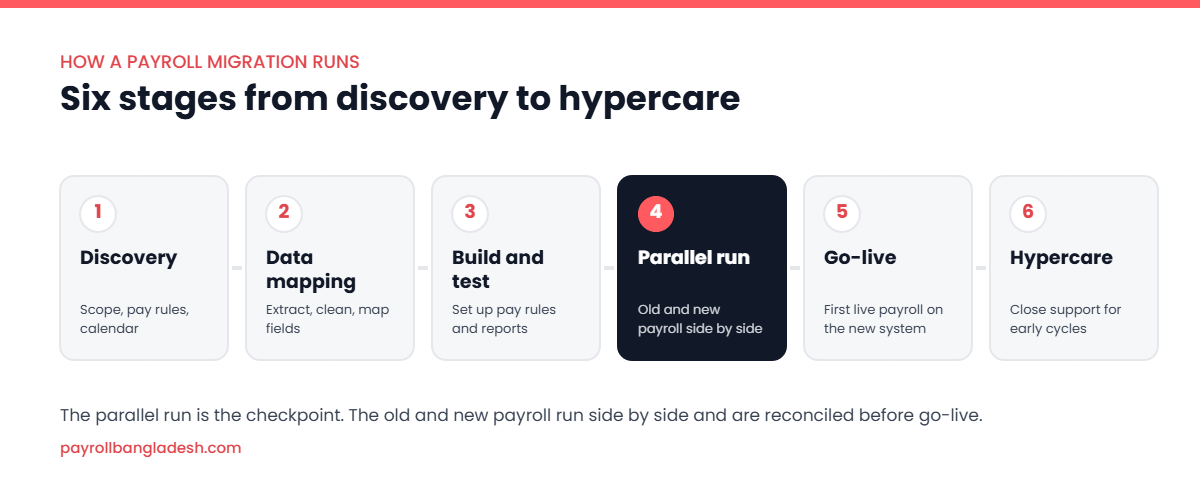
Illustrative plan. The length of each stage depends on headcount, data quality and the number of parallel runs agreed.
Why Run Payroll Twice?
For at least one pay cycle the same month’s payroll runs in both systems. We compare every employee line by line and explain each difference before you approve.
- Gross pay, deductions and net pay compared per employee
- Salary tax and fund contributions checked
- Every difference traced to its cause and fixed
- You sign off before the first live run
| Line | Old | New | Diff |
|---|---|---|---|
| Gross pay | 4,812,500 | 4,812,500 | 0 |
| Salary tax | 286,340 | 286,340 | 0 |
| PF contributions | 192,500 | 192,500 | 0 |
| Overtime | 61,200 | 63,450 | 2,250 |
| Net pay | 4,333,660 | 4,333,660 | 0 |
How Do We Keep Payroll Safe?
The risks in a payroll migration are predictable, which means they can be controlled rather than hoped away. Six things go wrong most often. Each one below names the risk, then the control we put against it before the switch happens.
Planned cutover date
The switch is set between two pay cycles, with the old process kept ready until the new one is proven. Section 123(1) of the Labour Act 2006 requires wages to be paid within seven working days of the wage period ending, so the cutover is planned backwards from that deadline rather than from a convenient calendar date.
Year-to-date tax carried over
Tax already deducted this income year is loaded, so annual calculations and returns stay right. The figure is reconciled against what was actually deposited to the National Board of Revenue, not against what the old system reported, because those two do not always agree.
Fund and leave reconciliation
Provident fund, gratuity service and leave balances are matched to the old records and signed off. Fund balances are reconciled to the trustee records held under section 264 of the Labour Act 2006, and your trustees sign the reconciliation before anything moves.
Field by field mapping
Every data field is mapped and checked, and exceptions are listed for you to confirm. Nothing is defaulted silently. Where the old system held a value we cannot interpret, it goes on an exception list with our reading of it, and you decide rather than discovering it in a payslip.
Controlled data transfer
Employee data is exchanged through agreed secure channels and access is limited to named people. Salary and bank data moves once, through a channel you approve, to a named list of people on both sides. Nothing is emailed as an open attachment and nothing is left on shared drives after the migration closes.
Clear employee communication
We help you tell employees what changes, such as a new payslip format, and what stays the same. Most of the questions after a switch are about things that did not change. Saying so in advance, in writing, removes the bulk of them before the first new payslip lands.
Which Payroll Rules Still Apply?
A migration changes the system, not the law. These three obligations survive the switch and set the dates the cutover has to be planned around.
| Rule | What applies | Source |
|---|---|---|
| Monthly wages | Paid within seven working days of the wage period ending | Labour Act 2006, s. 123(1) |
| Final dues on exit | Paid within thirty working days of employment ending | Labour Act 2006, s. 123(2) |
| Provident fund | Held by a trustee board with equal employer and worker members | Labour Act 2006, s. 264 |
Getting these wrong during a handover is the most common way a clean migration still produces a compliance problem months later.
Questions We Are Asked Most
These are the questions finance and HR teams ask before committing to a switch. Each answer states the position first, then the rule or the control behind it. If the question you have is not here, send us the detail and we will answer against your actual setup.
How long does a payroll migration take?
It depends on headcount, how clean your data is and how many parallel runs you want. We agree a go-live date at the start and plan every phase backwards from it, so the switch happens between two pay cycles. Section 123(1) of the Labour Act 2006 requires wages within seven working days of the wage period ending, so that deadline fixes the date rather than our convenience.
What is a parallel payroll run?
Running the same month’s payroll in both the old and new systems and comparing the results employee by employee. Any difference is explained and fixed before the new system goes live. You see the comparison before you approve the switch, so the decision to go live is yours and it rests on figures rather than on assurances.
What happens to tax already deducted?
We load each employee’s year-to-date salary and tax into the new payroll, so monthly deductions, annual totals and withholding returns stay correct for the whole income year. We reconcile that opening figure against what was actually deposited to the National Board of Revenue, because the old report and the deposit record do not always agree.
Will fund and gratuity balances carry over?
Yes. Provident fund balances and contribution history, and the continuous service dates used for gratuity, are migrated and reconciled against your old records before go-live. Section 264 of the Labour Act 2006 places the fund under a board of trustees, so balances are reconciled to the trustee records and signed off by your trustees rather than copied between systems.
Can we move staff in-house?
Yes. Once your subsidiary is registered, staff can move from the EOR to your company payroll. We plan the new employment contracts, final settlement or continuity of service, and the first payroll on your entity. Where service continues rather than ends, the original joining date carries over so nobody loses years already earned toward gratuity.
Can we switch provider mid tax year?
Yes, as long as year-to-date figures are carried over accurately. Many companies prefer to switch at the start of a quarter or income year, but it is not required. What matters is that the year-to-date tax figure moves accurately, because the new system otherwise restarts the annual calculation from zero and every employee is mis-deducted for the rest of the year.
What do you need from our provider?
Employee master data, pay structures, payroll registers and payslips for the current income year, tax and fund records, leave balances and outstanding loans. We send a data request list at the start. If your current provider is slow to release records we tell you early, because the registers and the year-to-date figures are the items you cannot reconstruct afterwards.
What happens after go-live?
Hypercare starts the day you go live. We give close support through the first payroll cycles, when queries peak and small configuration issues surface. The same team that ran the migration stays on the account, so nothing is handed to people who were not there. Once the cycles are running clean, the account moves to our regular payroll outsourcing service each month.
Plan Your Payroll Switch
Tell us where your payroll runs today, your headcount and your target go-live month. We will send a migration plan and quote.
PayrollBangladesh · Rupayan Shopping Square, Suite 610, Bashundhara R/A, Dhaka 1229 · +880-1711-990010 · info@payrollbangladesh.com
Have these ready
- Current employee list and pay structure
- This income year’s payroll registers
- Salary tax deducted so far
- Provident fund and leave balances
- Your target go-live month
Reviewed by Romana Akter Shila, Chief Executive Officer, PayrollBangladesh, 8 years in EOR and payroll operations.